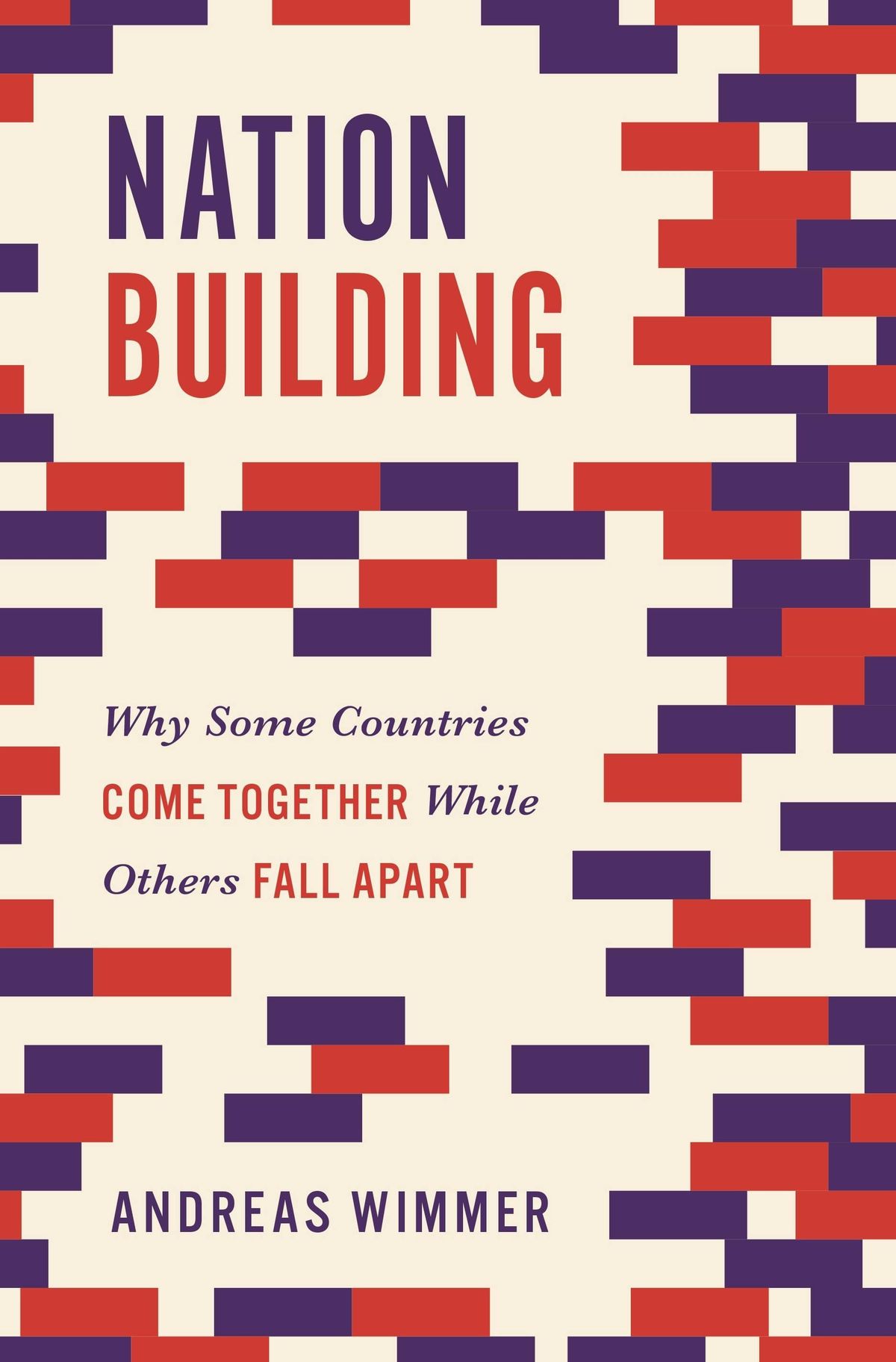
Nation Building: Why Some Countries Come Together While Others Fall Apart by Andreas Wimmer

Andreas Wimmer
Princeton University Press, 2018 · 376 pages · Princeton Studies in Global and Comparative Sociology
ISBN 9780691177380
- Claim: Countries hold together when every ethnic group shares central power, which happens where associations, public goods and a common language or script let alliances cross ethnic lines; the last two descend from states centralized before the nation-state.
- Against: The Washington usage after Afghanistan and Iraq that made nation building a synonym for democratization, and Acemoglu and Robinson's view that history hands out good institutions at random.
- Built from: Ethnic Power Relations data on who sat in government, 1946–2005; pride surveys from 123 countries; Asia Foundation surveys of Afghans; six paired national histories drawn from secondary literature.
- Start with: Chapter 4, "Communicative Integration: China versus Russia" (pp. 113–170), the chapter the critics fought over, with the book's one close case of the mechanism at work, the Jewish Bund (p. 145).
"No propaganda machine and no however well-crafted nationalist ritual, anthem, or tomb of the unknown soldier can substitute for the sense of belonging that emerges when one sees one's own kind of people in the seat of government" (p. 265)
As teenagers in a small town on the Rhine, Andreas Wimmer and his friends poled wooden punts upriver to find a clearing where they could make a fire and drink cheap Chianti from a carboy. The Swiss–German border there zigzags around German enclaves, and when someone came crashing through the trees the boys were, he writes, "unsure on which side of the border we were, we would have to wait to see the guard's uniform to discover whether he was Swiss or German" (p. xvii). The guards stopped to chat and never asked for papers. Nor did anyone at school care whether a classmate spoke French, German or Italian at home. The puzzle came later, when he looked at Belgium, Northern Ireland, Bosnia and South Africa: "Why didn't others simply deal with ethnic difference in a normal, that is Swiss, way?" (p. xviii). The preface calls the question naive. The book is the last of four he has written on it, a "quadrilogy" (p. xviii).
By the time he finished, the phrase in the title meant something else in Washington. After the invasions of Afghanistan and Iraq, think tanks used "nation building" for democratization, or for rebuilding states whose governments Western troops had removed, on the assumption that Washington could topple a regime so long as it then taught, in Francis Fukuyama's words, "these peoples to govern themselves" (p. 2). Wimmer reaches back past this to a literature he calls "largely forgotten": Karl Deutsch, Reinhard Bendix, Clifford Geertz and Edward Shils, who in the 1950s and 1960s asked how the new states of Africa and Asia could integrate their populations, and who were abandoned in the 1970s by Marxists, rational-choice theorists, multiculturalists and methodologists alike (pp. 2–3). He keeps their question and their habit of comparison and replaces their analogies with paired case studies and global datasets.
His present-day opponent is Daron Acemoglu and James Robinson's Why Nations Fail, which he retells as a fable. Nations are laboratory rats in a labyrinth, and the lucky ones blunder through a door into good institutions and plenty of food, sometimes to blunder back out (pp. 21–22). Against this he offers a "more deterministic view of history" (p. 22). Some rats are fatter than others, and "The likelihood that the fat rats will run through the door leading to nation building is consistently lower than the likelihood that the slim rats will end up there" (p. 22). Somalia, stateless in the late 19th century, has poorer odds than China with its two millennia of central rule. Eleanor Knott's introduction to the 2019 debate on the book in Nations and Nationalism reversed the metaphor: there, the rats that "start out fatter than others" are "more likely to succeed as nations, such as China".[1] On the page the fat rats are the less likely ones, and Somalia, not China, is the country with the poorer odds.
I. Nation building is every ethnic group sharing power, under any regime, and citizens identifying with the nation
Harris Mylonas objected to the definition before anything else. States built on an ethnic idea of the nation pursued assimilation and expulsion, he wrote in 2020, and "These types of policies have led to successful nation-building in various countries, albeit involving terrible death tolls and suffering".[2] His essay in the Nationalities Papers symposium called Wimmer's approach "conceptual stretching". The definition he had in view has two parts, "the two sides of the nation-building coin" (p. 1): political integration, meaning that majorities and minorities are tied to government through relationships of authority and support, and identification, meaning that citizens come to see the nation as theirs. The book shuts out his kind of success in advance: "Oppressing or even physically harming minority individuals shows that a nation-building project has failed—not that it is on the road to success" (p. 6).
The measure of integration is blunt. Using the Ethnic Power Relations dataset he built with colleagues, Wimmer counts the share of a country's population belonging to ethnic groups with no representative in national government, for 155 countries from 1946 to 2005 (p. 14), and calls it "a rough measurement" (p. 25). Democracy is kept out of the definition, and Chapter 5 is used to keep it out: "democratic regimes are more inclusionary because exclusionary regimes will remain autocratic rather than because democratization breeds inclusion and tolerance" (p. 189). The United States kept slavery for its first seventy years as a democracy (p. 2).
Zeynep Bulutgil, in her contribution to the same symposium, took the definition at its word and asked where it left France, whose schools pressed Breton-speaking children into standard French: "Is France a case of success or failure in terms of nation-building?"[3] Wimmer's reply to both ran fresh regressions and reported that wars and ethnic violence produced neither more inclusive governments nor, outside 19th-century Europe, more homogeneous populations.[4] On France it said only that the country would score high on all three of the book's conditions in the 19th century, which leaves the schoolroom where Bulutgil put it. Mylonas counts forced homogenization as success at a terrible price; the book counts it as failure (p. 6); the reply moves neither position.
The definition carries a moral preference, and the book states it with a reservation. "Many observers see nation building in a positive light, and so do I," Wimmer writes (p. 6), yet even inclusive nations shut out foreigners, and "Normatively speaking, nations remain as problematic as other political communities with strong membership rights" (p. 7). Six years later E-International Relations asked how his thinking had changed. "Substantially, my views on nationalism and the nation-state have become more positive," he replied, measuring the change against his earlier work on exclusion, and he called the belief in a borderless liberal world one that "was always an illusion".[5] The reservation on p. 7 does not reappear in the interview.
II. Where voluntary associations spread before the nation-state, its new rulers came from every language group
The theory concerns networks: associations build horizontal ties across a territory, while patronage runs vertically inside ethnic groups. Detailed network data for early 19th-century Switzerland and Belgium would test it directly. "No such information is available, however" (p. 45). The chapter can show only the order of events. Swiss associations came first, from the Helvetic Society of 1761 to the riflemen of 1824, their meetings rotating between cantons; the Helvetic Society heard its first speech in French in 1790. When the liberals won the short civil war and founded the federal state in 1848, they recruited from these mixed networks, and the federal council was multilingual from the first. Belgian associations before independence were French-speaking even in the Flemish north, where the bourgeoisie had shifted to French. Bulutgil asked why the two countries differed in the first place.[3:1] Pages 47–48 give three causes: confessional rivalry between cantons that made the clergy teach their flocks to read, a decentralized polity that could not easily suppress associations, and rural industry spread across the language regions. Wimmer's 2021 reply pointed her there and conceded that these are "historically specific factors" and that "the civil society factor is not endogenized in the theory offered in the book".[4:1] After 1830 French became the language of the state, and the organizations "that spoke in the name of the Flemish majority all developed a full generation after" independence (p. 64).
Philip Roeder's review in Perspectives on Politics, part of a 2020 exchange that paired the book with his own National Secession, read the Swiss evidence the other way round. A political Swissness had emerged early among elites in some cantons and "appears to have preceded and conditioned the emergence of cross-linguistic civil society".[6] The book had met this before Roeder wrote it. Wimmer sets the associations against Anthony Smith's reading of them as expressions of prior national sentiment, calls the Helvetic Society "proto-nationalist at best" (p. 51), and dates official nationalism late: "This changed from the 1880s onward, when an official, state-sponsored nationalism superseded republican patriotism" (p. 54). His answer in the same issue repeated that Swiss national identity, "at least at the mass level, was rather late to develop".[7] The reply shifts the ground. Roeder spoke of elites in some cantons; the reply speaks of the mass level, where the chapter offers no measure at all. On elites, the book's own evidence is that many Helvetic Society members were "also (and perhaps primarily)" men of their cantons (p. 51), which describes the people Roeder had in mind without settling which came first.
Sean Mueller, a political scientist at Berne, raised territory in Regional & Federal Studies in 2018. Switzerland was a federation of cantons, Botswana a set of kingdoms, and "Ironically from the point of view of the book's main argument about the value of early state centralization, precisely such non-centralization helped deliver public goods more efficiently than, for example, in the unitary monarchy of Belgium".[8] Chapter 1 already answers part of this. It says that centralized states sometimes nursed associations and sometimes crushed them, and "The two historical tendencies thus cancel each other out, in the aggregate and on average" (p. 33); Chapter 2 credits Swiss associations partly to "the decentralized nature of the political system" (p. 47). Centralization in the model predicts public goods and a common language, not civil society. Mueller's point about territory is not answered. He found the book "surprisingly silent on where exactly different groups reside", and the one place the chapter meets territory head on, the bilingual cantons where language is politicized, it sets aside in a note (p. 308).
A smaller discrepancy goes unremarked in the six reviews cited here. The introduction says the Flemish were ruled as an internal colony "despite forming a slight demographic minority" (p. 9); the chapter's own figures for 1846 put French and Flemish speakers at "roughly 42% and 50%, respectively, of the population" (p. 56). Mueller's "numerical majority" follows the chapter's figures rather than the introduction.
III. Where the state delivers public goods evenly, every group allies with the government, and minorities gradually assimilate
By 1976 Somalia's administration employed 72,000 people, fed by foreign aid, in a country where no telephone line ran between the former British north and the former Italian south (p. 103). In the first decade, party coalitions that had begun as clan blocs broke up, and alliances "formed along narrower clan and lineage identities—the opposite, in other words, of nation building" (p. 105). Siad Barre substituted campaigns for administration: a new script, secondary-school students sent to the countryside to teach nomads to read, literacy figures that, as the book notes after Laitin and Samatar, "are likely exaggerated" (p. 107). After a coup attempt in 1971 his regime narrowed to his own clan, his mother's and his son-in-law's (p. 109). The chapter rests on Ioan Lewis and on David Laitin and Said Samatar, and Wimmer adds a parenthesis to one judgment, "and I should add my even more limited expertise in Somalian matters" (p. 110). The acknowledgments thank Laitin for pointing out "some factual errors in the Somalia section" (p. xxi). None of the six reviews contests the Somali account.
Botswana is the counter-case, and Wimmer traces its success to the precolonial kingdoms: "the new state was built upon, not against, the Tswana kingdoms" (p. 77). Roads, schools, clinics and drought relief went to every region; cabinet and parliament came to mirror the population; and the share of people identifying as Tswana rose "from 55% in 1946 to over 75% in 2000" (p. 89). Brandon Stewart, reviewing in Democracy and Security in 2022, took the direction of that sequence as the book's main point against the economists: "the effective delivery of public goods increases linguistic and cultural assimilation, rather than the other way around".[9] Mueller, nearly four years earlier, had seen in Botswana's "multitude of regional kingdoms" the same irony as in the Swiss cantons. Of the eight Tswana kingdoms Wimmer writes, "They can best be described as centralized mini-states" (p. 72); centralization in his sense describes each kingdom's internal hierarchy of wards, headmen and kgotla, not a single precolonial capital, and he records that the kings proposed a federal Botswana in the 1960s and lost (p. 76).
The chapter counts the cost. Assimilation "comes with a price: minorities are pressured to assimilate into the dominant Tswana language and culture" (p. 93), and the Khoisan-speaking Sarwa remain wholly excluded. Mylonas's question came from outside the chapter. The Soviet Union also expanded public goods: "Why was public goods provision enough to lead to successful nation-building in linguistically heterogeneous Botswana but not in the USSR?" Wimmer answered that the three conditions substitute for one another, and that sequence decides: "This is not 'a contradiction,' as Harris has it, but a simple relationship of substitution."[4:2] By the time Soviet schools and clinics arrived, he added, the empire's politics had already split along language lines during the transition from empire.[4:3]
IV. A shared script let China's elites ally across spoken languages; Russia's many written languages kept alliances apart
In the early 18th century Ortai, a governor in the southwest, sent memorials of three to nine thousand characters to the emperor and waited three and a half months for the terse annotated replies (p. 118). The Han, over 90 per cent of China's population (p. 114), speak tongues that, by the test of mutual intelligibility, are separate languages; they are called dialects because none was ever politicized ("A language is a dialect with an army", p. 115, after Max Weinreich). The examination system recruited officials through the same script in every province, and Benjamin Elman's image of a scholar from Shanxi corresponding with a Cantonese colleague "even if communication only occurred in written form using a brush" (p. 119) is the chapter's picture of how the system worked. Provincial quotas for examination degrees kept the literati as polyglot as the empire (pp. 122–123), and the Kuomintang and Communist central committees drew on every region with no linguistic tilt (pp. 131–133). "The dogs of linguistic nationalism never barked among the Han Chinese" (p. 11). The Russian Empire's subjects spoke Finnish and German, Turkish and Romanian, written in Latin, Arabic, Cyrillic and Mongolian scripts (p. 11), and the parties of the late empire clustered by language.
Four of the six reviewers contested this chapter, most of them on the pairing. Knott relayed Vera Tolz's view that the Soviet Union was "more of an imperial configuration than a nation-state, as China is".[1:1] Roeder called it "mismatched": "ethnic Chinese and the multiethnic population of the Russian Empire, rather than comparing ethnic Chinese with ethnic Russians or pairing the multiethnic populations of the two empires".[6:1] Mylonas wondered whether nation building had even been attempted in Russia.[2:1] The book's case for the pair is on p. 140, where the Romanov empire "perhaps resembles Qing China the most" in size, absolutism and the timing of collapse, and its restriction on p. 115: "I am not concerned, therefore, with the Tibetan situation or the fate of the Muslim, Turkic-speaking population in the northwestern province of Xinjiang". Russia's Central Asians and Caucasians stay in; China's Tibetans and Uighurs stay out. Wimmer's replies gave two answers. To Roeder in 2020, that the Han population is "linguistically as diverse as that of the Russian Empire"; to Mylonas in 2021, that the tsars did try, through Russification from 1863 to 1905, while the Qing never did.[7:1][4:4] The first answer justifies looking at the Han; neither explains why the comparison stops at the Han border and not at Russia's. Bulutgil added that China, "which Wimmer treats as a case of success", holds together while oppressing whole groups.[3:2] The 2021 reply answered that the book had said as much: "As I stated repeatedly in the book, the China chapter disregards the situation of the non-Han minorities".[4:5]
The Russian half has a smaller admission. A detailed test, a "smoking gun", exists "only for one (even if important) case: for the mobilization of the Jewish population by the socialist Bund" (p. 145), whose Russian-speaking leaders switched to Yiddish to reach workers. For Poles, Finns, Balts, Tatars and Georgians, "I could not muster any direct evidence for the role of linguistic commonality" (p. 157). Roeder's further complaint, that the argument "focuses on associational life and communication within the elite", is answered for Russia on p. 159, where the mechanism is located in "the linguistic diversity of the literate population at large rather than that of the political elites". Bulutgil asked the same question of China by way of the Bund: why did the Chinese literate elite not have the Bund's difficulty in reaching peasants who were largely illiterate and spoke mutually unintelligible languages? Wimmer's answer in 2021 was chronological: China held its first elections only after the empire fell, Russia during it.[4:6]
V. Public goods capacity and a common language are legacies of states centralized before the age of mass politics
Journals turned down the statistical chapter several times before the European Sociological Review printed an earlier version; Wimmer thanks "the anonymous reviewers of this and a whole series of other journals where I unsuccessfully tried to publish the article before it found a happy home" (p. xxii). Its argument goes back two steps. Literacy, railway density and a high chance that two citizens share a language predict inclusive government; the reverse is checked with lags of about a century (p. 174) and with instrumental variables (p. 197). Then the conditions themselves are traced to states that existed by the late 19th century: 40 per cent more of a population under precolonial states raises the chance that two people in the early 1960s speak the same language by 17 per cent, "more than three times that of GDP" (p. 201). Behind those states sit mountains that kept peasants from escaping, and population density in 1500. Charles Tilly's dictum survives only for the West: "wars in the early modern period might indeed have propelled the formation of states in the West, while mountain ranges confining the peasant population had similar consequences outside of the West" (p. 205).
The regressions carry weight because the case chapters cannot. By the book's own account the paired cases are a "hoop test" that will "increase the plausibility of the theory proposed here but don't provide irrefutable evidence for it" (p. 42); Stewart cited the passage as jargon that would make even a graduate student "read this text very carefully".[9:1] Mueller saw the cost of the order in 2018: with the cases first, "one is left to trust the author that rivalling explanations will indeed be ruled out later on".[8:1] Mylonas pointed to what the regressions leave out. His own work with Keith Darden finds that external threats push governments to school their populations into one language; "Wimmer has not tested this argument in his statistical models, but instead categorized it as 'faster moving' (20)".[2:2] The book does not answer it. For Bulutgil the trouble was the date: the count of voluntary organizations begins in 1970, long after many of the transitions it is meant to describe; Wimmer reran the models with the V-Dem civil-society index and found its effect significant only within countries over time, a result he called "mixed".[4:7] The chapter's own last page concedes the larger gap: the alliance networks the theory is about are never measured. "I therefore could not show empirically that the reach of these alliance networks determines the power configuration in national government" (p. 207).
Stewart and Mueller both singled out Chapter 7's finding against the economists: diversity does not depress public goods once a country's history of statehood is controlled, because both diversity and weak states descend from the absence of an early state. Wimmer puts it as "Diversity is not destiny, but a product of history" (p. 18). The tables are more qualified than the slogan. Once precolonial statehood enters the models, "diversity is no longer significantly associated with any of the three measurements" (p. 237), but the sample has then shrunk to Africa and Asia, and Alesina's index of linguistic fractionalization "remains weakly significant" (p. 237). Korea, with a thousand years of state building, against mainland Tanzania, with none before colonization, is the contrast the chapter ends on (p. 247).
VI. Members of groups shut out of national government are far less proud of their nation
"In Nation Building the interchangeability of the concepts and processes of national identification, pride, precedence, and integration seems warranted," Roeder allowed, before asking the next researcher to pull them apart.[6:2] The book had pulled two of them apart in a note. Chapter 6 pools surveys from 123 countries, some 770,000 respondents, all asked how proud they are of their nationality, and matches respondents to ethnic groups in 64 countries. Members of groups discriminated against in national politics score about 1.5 points lower on a four-point scale (p. 17), "two standard deviations less proud than included groups" (p. 224). Germans are the least proud people in the data (p. 219). But Wimmer is clear that pride "refers to the moral, evaluative component of national identification rather than the strength of the attachment" (p. 218), and note 8 reports that pride correlates at 0.08 with whether a respondent identifies first with the nation rather than an ethnic group, across some 92,000 answers (p. 314). On the book's own figure, pride and precedence are close to unrelated, though the chapter's title speaks of identifying with the nation.
Measured as pride, the effect is large: "If political integration fails, in other words, the imagined community of the nation means much less to its members" (p. 224). To test whether exclusion lowers pride or proud groups get admitted, Wimmer follows eight groups whose status changed; two, both Bolivian, go the wrong way, and he calls the result "far from conclusive" (p. 226).
VII. Public goods win a government more loyalty when it delivers them itself rather than through foreigners
In 2024 Wimmer described the choice facing aid donors as a trade-off. National governments in the Global South may be less efficient, international organizations and NGOs more so, but the habit of having the most efficient provider deliver public goods, wherever it comes from, "obviously stands at odds with the idea of nation-building".[5:1] He applied the same logic to Europe: "Only when citizens exchange their taxes and political support against public goods, security, and social solidarity directly provided by the European Union will this dynamic change".[5:2] Knott had asked in 2019 whether the EU could be read as a failed nation-building project.[1:2] The book had given its view before either: the EU "seems to have failed" at nation building on a European level (p. 5).
The evidence for the trade-off is Afghan. From 2008 to 2012 the Asia Foundation's annual Survey of the Afghan People asked respondents who had funded the development projects they had heard of nearby: the Afghan government, foreigners, or both (p. 257). Any project, whoever paid for it, improves views of the government, but foreign projects "don't increase satisfaction with government nearly as much", about half as much as government ones; a government project is roughly twice as effective at leading people to take local disputes to state officials rather than elders or warlords; and respondents with foreign-funded projects nearby are more likely to call the Taliban insurgency justified (pp. 259–260). Stewart drew the policy conclusion: the attempt to win "hearts and minds" through development was "only moderately effective at best and completely counter-productive at worst".[9:2] Mylonas questioned the premise. The result assumes "an information rich environment where the local population actually knows enough about the role of external actors"; would covert support work better?[2:3] The book cannot say. Its estimates depend on what respondents believed about the sponsor, and Wimmer adds that he has no data at all on the intermediaries, the shura members and police chiefs, through whom projects reach villages (p. 258).
One result in Table 8.1 points the other way. Among the major infrastructure projects, water, roads and irrigation, government sponsorship improves how Afghans see their government. Schools do not. Respondents who report "a government-sponsored education project see the Afghan government in a less, rather than more favorable light" (p. 262), a finding Wimmer calls interesting and "somewhat difficult to interpret".
The flyleaf
- p. xvii. The Rhine border, the punts and the guards who never asked for papers: where the question began.
- p. 9. "A slight demographic minority": the introduction's error about the Flemish, contradicted on p. 56.
- p. 20. Figure 0.2: the whole causal chain from topography to national identification.
- pp. 21–22. The rats in the labyrinth, against Acemoglu and Robinson; inverted in Knott's introduction.
- p. 33. Why prior centralization does not predict civil society; the answer to Mueller's federal objection.
- p. 42. The "hoop test": what the paired cases can and cannot prove.
- p. 51. The Helvetic Society as "proto-nationalist at best"; the passage Roeder's Swissness objection runs against.
- p. 72. The eight Tswana kingdoms as "centralized mini-states".
- p. 110. The admission of "limited expertise" on Somalia.
- p. 115. The China chapter confined to the Han; the line the pairing dispute turns on.
- p. 140. The case for comparing Qing China with the Romanov empire.
- p. 189. Democracy as the consequence, not the cause, of inclusion.
- p. 207. The concession that alliance networks are never measured.
- pp. 260–262. Table 8.1 and the education-project anomaly.
- p. 314. Note 8: pride and nation-first identification correlate at 0.08.
The shelf
- Argues with: Daron Acemoglu and James A. Robinson, Why Nations Fail (Crown, 2012). The rats in its labyrinth find good institutions by luck; Wimmer's are weighted by history.
- Builds on: Karl W. Deutsch, Nationalism and Social Communication (Technology Press of MIT and Wiley, 1953). The source of the communication mechanism in Chapter 4.
- Read against: Harris Mylonas, The Politics of Nation-Building (Cambridge University Press, 2012). Explains assimilation, accommodation and exclusion by external threat and alliances, which Wimmer files among the faster-moving forces.
- Read against: Benedict Anderson, Imagined Communities (Verso, revised edition 1991). Print and bureaucratic pilgrimage as the makers of nations; Chapter 1 claims a more parsimonious network account.
- Builds on: Eugen Weber, Peasants into Frenchmen (Stanford University Press, 1976). The French model behind the Botswana chapter's "tribesmen to Tswana".
Eleanor Knott, "Introduction to Nations and Nationalism 2018 Book Debate: Andreas Wimmer (2018) Nation Building: Why Some Countries Come Together While Others Fall Apart", Nations and Nationalism 25, no. 1 (2019): 82–84, https://doi.org/10.1111/nana.12487. Quoted from the accepted version on LSE Research Online. ↩︎ ↩︎ ↩︎
Harris Mylonas, "The Determinants of Successful Nation-building: Macro-sociological Political Modernization and Political Alliance Structures", Nationalities Papers 50, no. 1 (2022): 185–189, published online 17 December 2020, https://doi.org/10.1017/nps.2020.97. ↩︎ ↩︎ ↩︎ ↩︎
H. Zeynep Bulutgil, "Paths for Future Research on Nation-building: Causal Mechanisms and Theoretical Antecedents", Nationalities Papers 50, no. 1 (2022): 190–192, published online 10 February 2021, https://doi.org/10.1017/nps.2020.104. ↩︎ ↩︎ ↩︎
Andreas Wimmer, "Alternative Routes to Nation-building? A Response to Zeynep Bulutgil and Harris Mylonas", Nationalities Papers 50, no. 1 (2022): 193–201, published online 13 January 2021, https://doi.org/10.1017/nps.2020.96. ↩︎ ↩︎ ↩︎ ↩︎ ↩︎ ↩︎ ↩︎ ↩︎
"Interview – Andreas Wimmer", E-International Relations, 9 March 2024, https://www.e-ir.info/2024/03/09/interview-andreas-wimmer/. The address now redirects to the site's home page; the text was reposted in the site's archive in August 2026. ↩︎ ↩︎ ↩︎
Philip G. Roeder, review of Nation Building, Perspectives on Politics 18, no. 1 (2020): 221–223, https://doi.org/10.1017/S1537592719004924. ↩︎ ↩︎ ↩︎
Andreas Wimmer, "Response to Philip G. Roeder's review of Nation Building", Perspectives on Politics 18, no. 1 (2020): 223–224, https://doi.org/10.1017/S1537592719004936. ↩︎ ↩︎
Sean Mueller, review of Nation Building, Regional & Federal Studies (2018), published online 27 September 2018, https://doi.org/10.1080/13597566.2018.1528238. ↩︎ ↩︎
Brandon Stewart, review of Nation Building, Democracy and Security 18, no. 1 (2022): 95–97, https://doi.org/10.1080/17419166.2022.2029003. ↩︎ ↩︎ ↩︎