Alexander: God, King, Man by Edmund Richardson
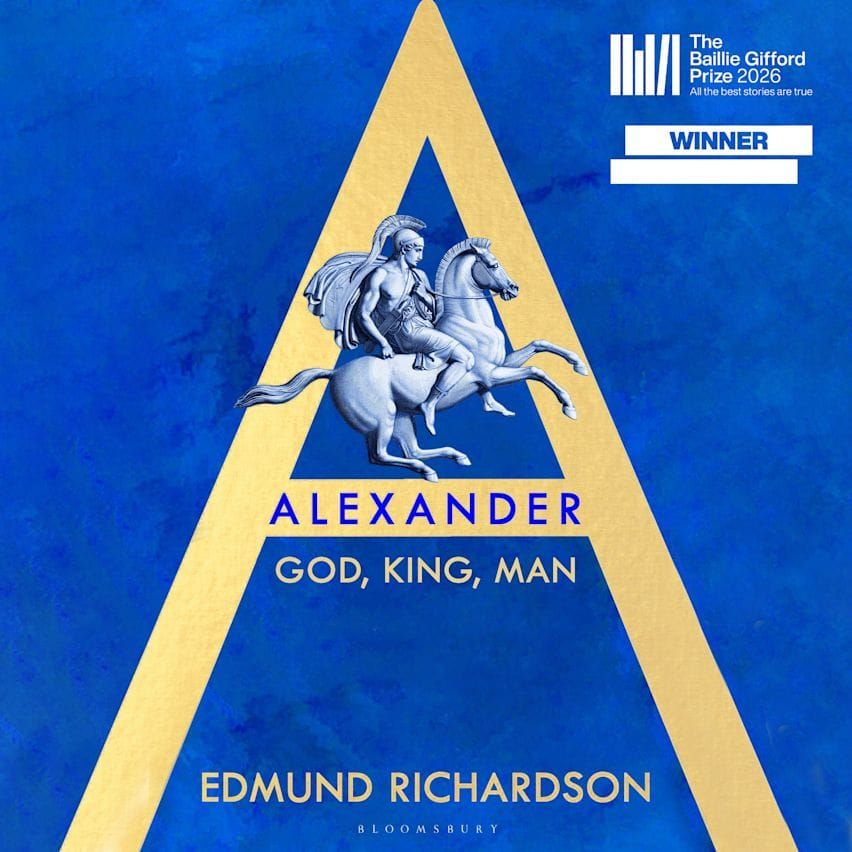
Alexander: God, King, Man
Edmund Richardson
Bloomsbury, 2026 · 480 pages
ISBN 978-1-5266-5817-3
- Claim: Alexander, a bankrupt young king, held power through fear and through stories about himself until he could not tell the stories from himself; Egyptian, Babylonian and Indian records show what Greek histories left out.
- Against: The single-key Alexanders of the last century (Lane Fox's second Achilles, Tarn's philosopher king, Bosworth's genocidal psychopath), all drawn from Greek and Roman histories written centuries later, under Rome.
- Built from: Arrian, Plutarch, Curtius and Diodorus beside Babylonian astronomical diaries, Egyptian stelae, Aramaic records from Bactria and the Arthashastra; translations from twelve ancient languages; modern models of eclipse, desert and river.
- Start with: Chapter 13, "Earth and Heaven" (pp. 164–79), where Babylon crowns Alexander from a ritual tablet and one endnote admits that no Greek or Roman source saw it happen.
"But for Alexander, sitting on the throne of Darius, surrounded by the Great King’s court, it was becoming harder to know where the stories ended and where he himself began." (p. 185)
When cloud covered Babylon, the astronomers still wrote. Their clay diaries, kept night after night for centuries, give the positions of stars they could calculate but not see, and beside them the old Sumerian formula nu pap, "I could not see" (p. 2). Edmund Richardson opens his book in that archive at one o'clock on the morning of 5 November 333 BCE, with the Lion high over the Ishtar Gate, and keeps the clock running: the moon down a little before two, Regulus in the east, Venus, Mars and Jupiter hanging in the sky at five, while on a hill above the plain of Issus a twenty-three-year-old king prays among guttering torches (pp. 1–8). None of these hours carries a note. Talking to Pete A. Turner and Max Nikias on Turner's Break It Down Show, Richardson explained that software can now place the moon and planets for the night Alexander looked up, and then supplied the qualification his first chapter leaves out: "obviously this isn't infallible. For all we know, it could have been a cloudy night."[1]
Most of what reviewers argued about lies in the gap between that sentence and the chapter. The book's back matter lists the last century's versions: "For Robin Lane Fox, Alexander was a second Achilles. For W. W. Tarn, he was a philosopher king who longed to unite the world. For A. B. Bosworth, he was a genocidal psychopath." (pp. 397–398) The list goes on to Peter Green's megalomaniac schoolboy and Fritz Schachermeyr's Hitler. All of them worked from the same few narratives, by men who wrote "centuries after Alexander’s death, in a world which had been transformed by the power of Rome" (p. 397). Richardson adds no new key: "There will never be a definitive Alexander." (p. 398) He claims instead that the evidence has moved: diaries from Babylon, a prophecy tablet first published in 2025, the stele of an Egyptian priest who stood in the Persian line at Issus, ration lists in Aramaic from Bactria, a Sanskrit manual of war.
James Romm, a classicist four of whose own books and articles stand in the bibliography, set out the old difficulty in his review for the TLS in August 2026. The surviving histories split into a "sensationalizing" vulgate, represented by Curtius, and "the less florid versions of two Greeks, Plutarch and Arrian", and nothing survives in Alexander's own words. Richardson's answer, in Romm's phrase, was "part novel, part biography".[2] The Economist had already praised in June what Romm would deplore: "Where there is a good story to tell, Mr Richardson does not deconstruct or critique it. He tells it, with gusto."[3] Richardson's first chapter closes on a sentence Antony Spawforth would quote against it in the Literary Review: before Issus, "Alexander was still just a frightened young man, standing alone beneath the stars, praying to every god who might listen" (p. 8).
I. Alexander came to the throne bankrupt and frightened, and learned at Thebes to rule by fear
Spawforth, writing in July 2026, quoted that sentence as an instance of a style that "happily flirts with ‘faction’".[4] He placed it before the Granicus, the first battle in Asia, and asked: "Was he, though?" Plutarch and Arrian, in his reading, show a leader confident enough to overrule Philip's most seasoned general.
The sentence belongs to a different night. It closes the first chapter, before Issus, eighteen months after the Granicus, and the fear there has an ancient author: Curtius, quoted four pages earlier, "His confidence had given way to dread" (p. 4). At the Granicus the book does what Spawforth asks of it. Alexander and Parmenio look at the steep, bramble-covered banks; Parmenio advises making camp; Alexander says he would be ashamed to waver "because of this little stream" (p. 54) and orders the attack. What Richardson adds is one unsourced sentence: "But Alexander was anxious." (p. 54) Spawforth misplaced his quotation. His objection still lands, four chapters later, on the word "anxious".
Romm pressed the same point at Issus itself. He quoted the night on the hill, Alexander trying "to quiet his fear", as a passage that "freely imagines Alexander’s emotions or state of mind with no historical support".[2:1] Here Romm overstates. The next sentence in the book is Curtius again, quoted by name: "He was far from sure that he would be victorious" (p. 7). The fear has a source; it is not labelled. Romm's larger complaint was exactly that: the book's habit of "according equal weight to widely disparate sources and not mentioning their contradictions".[2:2] The reader is never told that Curtius is the sensational branch. The book's own statement of method, buried in the back matter, is that it aims "to follow the ancient sources as closely as possible, while occasionally adding in context which would have been familiar to many ancient readers" (pp. 398–99). Which ancient source is being followed is left to the endnotes.
The chapter on the accession explains the fear, and the explanation is money. When Alexander opened his father's treasury he found a few gold and silver cups and silver enough to pay the army "for less than a month" (p. 42), against three million drachmas of debt Philip had run up in secret (p. 44). He cancelled all taxes to win the Macedonians over, and from that moment "The Macedonian state would no longer be self-sufficient. Instead, it would be a predator, plundering to survive." (p. 40) Max Carter, the Christie's chairman who reviewed the book for the Wall Street Journal in October, took the book's phrase "beg, borrow and loot" (p. 40) as the key to the early campaigns.[5] Richardson himself, on Turner's show, was less single-minded than his chapter: "I sometimes think all of the stories are true to an extent", and then gave the bankrupt state as one of them.[6]
Thebes supplies the method. The city rebelled, mocked Alexander from its towers, and fell after one of his officers attacked without orders. "But the lesson he took from Thebes was a grim one: aggression, not compromise, was the way to his men’s hearts. And fear, not love, was what would keep him on the throne." (pp. 46–47) On this the interview and the book agree. Richardson told Nikias that the army would "reward directness and attacking and not negotiating and not showing mercy".[7] Alexander spared the poet Pindar's house and sold the Thebans: "Alexander’s campaign for Greek freedom would be paid for by selling Greeks into slavery." (p. 47) As the army prepares for Asia, the chapter gives its verdict in five words, "He had no real plan." (p. 48), and then Alexander's own, when Perdiccas asks what he has kept for himself after giving his friends farms and villages: "My hopes." (p. 48)
II. Greek and Roman histories omit what Greeks found foreign; Egyptian and Babylonian records restore part of it
"In Greek and Roman histories, Alexander’s coronation blurs and vanishes." (p. 98) The book has him crowned pharaoh at Memphis late in 332 BCE. In the Greek historians the ceremony survives as a festival of athletes and musicians shipped in from Greece. "While Greek and Roman authors were happy to put Alexander in a foreign king’s bath, they were less comfortable putting a foreign king’s crown on his head." (p. 98) Richardson calls the omission "a pattern which would be repeated across Alexander’s lifetime" (p. 98), and the book's newest material is gathered to fill the holes the pattern leaves.
The one eyewitness among the new material speaks from a stele now in Naples. Somtutefnakht, a priest of the god Hersef from Henen-Nesut on the Nile, was conscripted into Darius's army and stood barefoot in the line at Issus. "The only person who ever faced Alexander’s phalanx and survived to write about it afterwards was Somtutefnakht" (p. 16), and what he wrote was a thanksgiving: "‘A million died at my side,’ he remembered later. ‘But no one raised their arm against me.’" (p. 16) Romm, severe elsewhere, singled out this testimony as one "that will be unfamiliar even to many Hellenists".[2:3] Beside it Richardson sets a Babylonian prophecy tablet in the British Museum, "published for the first time in 2025" (p. 149), which promises Darius victory over Alexander and closes by promising the Babylonians a tax cut, and a cache of Aramaic documents from the eastern provinces in which, in the winter of 330–329, Persian officials receive orders for food and camels from two Great Kings at once, Bessus and Alexander (p. 220).
Spawforth set the same finds in quotation marks. The documents were discovered "‘recently’ in a Pakistani bazaar", he noted, and "Despite new ‘fringe’ discoveries, Richardson relies" on Plutarch, Arrian and the rest, like every modern biographer.[4:1] Romm's point holds for the people around Alexander, Spawforth's for Alexander himself. The new material changes what can be known about the first: a conscripted priest, Babylonian scribes forecasting victory for Darius, a provincial clerk counting camels. Where it reaches Alexander himself, the book leans on reconstruction and says so only in the notes. The Babylonian coronation of chapter 13 is narrated from a late ritual tablet, and the endnote concedes that "there is no direct account of this ceremony in the surviving Greek and Roman sources" (p. 434), and infers the ceremony from a later episode in Arrian. The coronation at Memphis rests on the Alexander Romance, which another endnote calls "a deeply (joyfully) questionable text" (p. 427).
On Turner's show Richardson gave one reason for distrust: Plutarch paired Alexander with Julius Caesar and shaped each life towards the other, so that "we're reading a Roman Alexander rather than a Greek Alexander or a 4th century BC Alexander".[8] Alexander is least in charge in the Babylonian material: in the diary for October 331 that records, with no comment, "Alexander, king of the universe, entered Babylon" (p. 168), and in a book whose chapter on that city concludes that "Babylon transformed its conquerors far more profoundly than its conquerors could transform it" (p. 171).
III. Alexander built his power on stories about himself, and the stories came to rule him
Two reviewers quoted the book without a word it contains. Rupert Christiansen, in the Daily Telegraph in June, thought it a "strikingly grandiose claim" that Alexander "reshaped reality more profoundly than anyone else in history", and asked whether Caesar, Genghis Khan or Napoleon had done less.[9] Andrew Lynch, in the Irish Times in August, quoted the same words and called the claim "grandiose" too.[10] On the page the sentence reads "more profoundly than almost anyone else in history" (p. 8). Ioan Marc Jones kept the "almost" when he quoted it in the Guardian on 4 November 2026, the day the book won the Baillie Gifford Prize, the first history of the ancient world to win it.[11]
The book does make the stronger claim, later. When Alexander is twenty-nine and fighting in the hills beyond the Hindu Kush, the narrator says that "he had reshaped reality more profoundly than anyone before him in history" (p. 259). By then the conviction is also Alexander's own. In Bactria, "For years, Alexander had carried with him a certainty: that reality could be remade." (p. 222) In Sogdia the narration slips into his voice: "Was not reality his?" (p. 243) The claim about reality starts with the historian and ends in the king's head, and the book's argument runs along that line.
It starts with performance. At the Granicus the omens are rigged, a soothsayer's hand marked before he reaches for the liver (p. 55); at Gordion the prophecy about the knot has no record before Alexander arrives. "The real trick of the Gordian Knot was not the tightly wound cords around the yoke of the wagon. It was the story itself." (pp. 63–64) For Carter, Richardson "treats legends with similar care".[5:1] At this stage Alexander is in on the trick: "He saw through his own performance." (p. 52) The turn comes at Siwa, a march into the Libyan desert for which "There was no military reason" (p. 128). A priest of Amun stumbles over his Greek and seems to say "O son of god"; Alexander says nothing to confirm it, and "If Alexander did not openly encourage this story, he also did nothing to quash it." (p. 133) Then: "The journey had been intended to transform how people saw Alexander. But it had, in fact, transformed him. Expediency had turned to awe" (pp. 134–135). By Susa the king on Darius's throne can no longer tell where the stories end. By the Hyphasis, in India, a rumour of a vast Nanda army stops him where no army had: "Now a story about an army, not an actual army, had cracked his power." (p. 291)
On Turner's show Richardson gave the political logic: to rule Greeks, Macedonians, Egyptians and Persians at once, Alexander "had to have all of these stories about himself going on at once".[12] David Keymer, reviewing the American edition for Library Journal in July, described an Alexander who "lived in a mythic world of gods and heroes".[13] Spawforth objected to one link in the chain. Richardson, in his account, "accepts Alexander’s alleged request for deification towards the end of his life, despite the considerable problems with the evidence".[4:2] The page bears him out. The account of the Greek embassies to Babylon begins from "Alexander’s invitation to worship him had not been welcomed in Greece" (p. 343). The Spartan and Athenian replies are sourced; the invitation itself is an assumption. And the arc from showman to believer, as Romm complained of the book generally, is told from inside Alexander's head. The ancient sources say less. After Siwa, the book quotes Arrian: "‘That, anyway,’ wrote Arrian, somewhat wryly, ‘was his version of events.’" (p. 133) The official history went with Callisthenes, whose work broke off on the day of his arrest. In the book's phrase, "the empty space told its own story of who Alexander was becoming" (p. 246).
IV. Alexander's army killed people who posed no threat, and the legends of the campaign cover it
The book's largest number, that "almost 1 per cent of the world’s population would die as a direct result of his campaign" (p. 8), has no note. Reviewers repeated it with hedges of their own. Patrick Kidd, in The Times in May, hedged with "it is claimed"[14]; The Economist with "some have estimated".[3:1] Lynch doubled it to "roughly 2 per cent".[10:1] The Economist also counted the book's own violence: the word murder 38 times, kill about a hundred.[3:2]
The argument rests instead on sieges where Richardson reverses what his sources report. Aornos, the crag above the Indus that Heracles was supposed to have failed to take, comes down in Arrian and Curtius as a fortress stormed. Richardson takes the source's phrase for the people on the summit, "driven into the mountains" (p. 260), and turns it round: "There was no garrison of experienced soldiers. In fact, there was no garrison at all." (p. 260) The summit held farmers, priests and mothers. "Alexander was besieging a refugee camp." (p. 260) The reinterpretation is the book's, and it says why: "The mist of fable covers every surviving ancient account of the siege." (p. 263) On the lower Indus the method is bolder. The line the endnote takes from Arrian, that the Malavas "had more men, and fiercer warriors, than any other Indian people" (p. 297), appears in the book as what Alexander told his men, while the narrator states the opposite: "The Malavas posed no danger – they were mostly farmers and craftsmen." (p. 297) The narrator's judgment overrides the quoted source, and the verdict follows: "His expedition was no longer one of liberation, or even of conquest. It was one of annihilation." (p. 298) The endnote points to Bosworth's comparison with Cortés.
At Persepolis, which opened its gates without a fight, the soldiers killed "not because the city was a threat or because they profited from killing, but simply because they could" (p. 195), and the palace burned after Alexander had emptied it of gold, "no more an accident than the murder of the people of Persepolis" (p. 198). The author was less certain aloud than on the page. Asked by Nikias why the palace was destroyed, Richardson gave revenge for Xerxes' burning of the Acropolis and then stopped: "what exactly he was thinking will in many ways always be a mystery. But this is my best guess".[15]
V. Alexander could conquer the Persian empire but could not govern it
At Opis on the Tigris in 324, after his veterans had mutinied and been reconciled, Alexander gave them a farewell banquet, Macedonians in the inner ring around him and Persians beyond, and prayed. Richardson translates Arrian: Alexander prayed "that Macedonians and Persians might be of one mind, and build one society together" (p. 337). Spawforth objected to the Greek. What Arrian has Alexander ask for is koinōnia tēs archēs, and "The Greek translates as ‘joint rule of the empire’."[4:3] A partnership of two ruling elites is a different thing from a single society, and the difference is old ground. The book's bibliography lists both W. W. Tarn's 1933 paper in the Proceedings of the British Academy and Ernst Badian's 1958 article in Historia, each titled "Alexander the Great and the Unity of Mankind". The note to the prayer cites Arrian 7.11 and nothing else. The book does not answer Spawforth here.
Spawforth also wrote that Richardson subscribes to Augustus's view that Alexander had no idea how to administer his conquests, and the book does not deny it: "Being an administrator, not a conqueror, was beyond Alexander." (p. 332) Lynch read the same portrait as an autocrat "with no real political vision beyond collecting territories".[10:2] The case begins in the Gedrosian desert, which Richardson reconstructs with an agent-based simulation, uncited in the notes, after a fair warning: "Agent-based simulations cannot, generally, predict a single person’s behaviour with any accuracy." (p. 308) By the book's count, "Of the 20,000 people who had followed him into the desert, fewer than 10,000 were left." (p. 314) When Alexander came out, "the world had gone on without him" (p. 315): in Babylon the imperial treasurer, Harpalus, had made himself "king in all but name" (p. 315). The chapter's verdict follows: "Alexander’s campaign had broken the old world, but he had not built a new one." (p. 318)
The evidence on the same page as the administrative verdict pulls the other way. The old Persian bureaucracy, Richardson writes, kept the empire running. In Bactria that June, "in the seventh year of Alexander the king" (p. 332), barley was handed out by Vakhashudata, the barley-supplier, to goose-keepers and slaves, in neat Aramaic on leather.
VI. Alexander died of typhoid caught from Babylon's water, not of poison or of wine
The astronomers of Babylon recorded the death in three words, "The king died." (p. 363), and Richardson holds that they were early. "But Alexander was not dead. The final stages of ascending paralysis can mimic death almost perfectly." (p. 363) The case for typhoid is made a few pages earlier. The army's vast camp lay upstream of the city. In May the Euphrates fell and slowed, and "A simulation suggests that bacterial concentration in the river water would have increased more than fivefold during May." (p. 359) No study is cited for the simulation. The diagnosis itself is taken from a 1998 paper by D. W. Oldach and colleagues in the New England Journal of Medicine (p. 455, n. 99); the paralysis comes from Katherine Hall's 2018 article in the Ancient History Bulletin, which asks whether Alexander died of Guillain–Barré syndrome (p. 456, n. 115), a different disease, here grafted onto the first. Poison is dismissed in a sentence: Eumenes' later list of the guests at Alexander's last party was "a very convincing fabrication" (p. 356), with no note.
The chapter mixes its moods on a single page. The water "would have carried massively unsafe levels of Salmonella typhi" (p. 359); earlier on the same page, without a conditional, "But it was not wine which had caused Alexander’s condition, it was water." (p. 359) A page later the conditional returns: "Alexander may have been infected around 16 May" (p. 360).
The reviewers took the diagnosis with differing confidence. In Kidd's May review, "It was not the wine that did for him, Richardson suggests, but Salmonella Typhi in the water."[14:1] For Carter, "Mr. Richardson infers typhoid".[5:2] The Economist reported that he "thinks drinking water and typhoid are more likely".[3:3] Christiansen settled on "what was probably typhoid".[9:1] Only James Carey-Douglas, in the Daily Mail in June, dropped the hedge entirely: Alexander "would die of typhoid in Babylon".[16] None of the five quoted the book's conditionals, and none questioned the diagnosis.
Near its end the chapter turns to the answer Alexander's friends said he gave when they asked to whom he left his empire. "‘To the strongest’ is how the words are traditionally translated." (p. 362) Richardson hears Homer in them instead: "Toi kratistoi: ‘To the one who will not be broken’; ‘To the one who can endure it’." (p. 362)
VII. Alexander's empire broke up when he died, but the connections it made between cultures lasted
Spawforth accepted the book's last claim and declined to be impressed by it: "It is not a new argument, though it is a valid one."[4:4] The epilogue gives each half a sentence. "Alexander had hoped to remake the world. Instead, he left it in ruins." (p. 375) And two pages on: "Unlike his empire, those connections endured." (p. 377) Christiansen and Carey-Douglas took one half each. Christiansen took the first sentence and doubted the second: if Alexander reshaped reality, "it was for the worse".[9:2] Carey-Douglas took the second whole: Alexander had "stitched parts of the world together".[16:1]
The test case is Alexandria. Spawforth objected that the book lauds the city as "Alexander’s greatest achievement" when its brilliance was the work of the Ptolemies.[4:5] The book has already answered him. The phrase on p. 108 is followed at once by "That, at least, is how the tale is often told." (p. 109) Four pages later: "The Library was not, however, Alexander’s." (p. 113) "Alexander could think a hundred miles ahead. Ptolemy could think a hundred years ahead." (p. 113) Spawforth's point survives only at p. 116, where the Library becomes, "Of all the ripples set in motion by Alexander’s life" (p. 116), the one that has spread furthest. It is the sentence Jones chose to quote.[11:1] The book's evidence for contact is most candid at Taxila, in the spring of 326, where Greeks and Indian ascetics talked through three interpreters, one of whom mistranslated "pleasure" (p. 270); the young Chandragupta's sight of Alexander's cavalry is inferred from a single Greek loanword in the Arthashastra, and the book says so: "Neither the Indian nor the Greeks ever wrote about that moment" (pp. 273–74). In conversation Richardson stated the claim more broadly than any page: knowledge began to travel "far faster and far more fully than ever before".[17]
Christiansen, closing his review, credited Lucan with describing Alexander's career as "a nightmare which humanity was still struggling to wake from".[9:3] The words are Richardson's, introducing Lucan's poem (p. 375). The epilogue has its own case of words changing hands. Ptolemy, who stole Alexander's body, also wrote his life, and his memoirs were stuffed with his own heroism; "Arrian trusted Ptolemy’s memoirs more than any other work" (p. 371), because a king would be too ashamed to lie. The last scene of the epilogue belongs to Onesicritus, once captain of Alexander's flagship, reading his old friend Lysimachus, now king of Thrace, the new volume of his memoirs, in which Alexander meets the queen of the Amazons and falls in love. "‘Tell me,’ he asked, ‘where was I then?’" (p. 380)
The flyleaf
- p. 2. Nu pap, "I could not see": the astronomers' note for a cloudy night, set against the book's unsourced hour-by-hour sky for 5 November 333 (pp. 1–8).
- p. 8. The programme: "almost anyone else in history", the unsourced 1 per cent, king to hero to god. Christiansen and Lynch quoted it without "almost".
- p. 16. Somtutefnakht's stele, the only first-hand account of facing the phalanx; the find Romm singled out.
- p. 31. "Alexander had a lot of sex with a lot of people, both men and women": no note; Romm set Plutarch's restrained Alexander against it.
- pp. 54–55. The Granicus: Parmenio overruled, Alexander "anxious", and the "one more glorious charge" Romm traced to Polyaenus.
- pp. 63–64. The Gordian Knot as a prophecy invented on arrival.
- p. 98. The pattern: Greek and Roman sources record only what Greeks would recognise. The book's case for its evidence in one paragraph.
- pp. 108–16. Alexandria and the Library: "how the tale is often told", Ptolemy's foundation, and the "ripples" sentence Spawforth and Jones read differently.
- p. 149. The Babylonian prophecy tablet, published 2025, promising Darius victory and a tax cut.
- p. 220. Aramaic documents from Bactria: requisitions from two Great Kings in one winter.
- p. 260. Aornos read as a refugee camp.
- p. 308. The agent-based model of the desert march, with its own caveat.
- p. 337. The Opis prayer, "build one society together"; Spawforth's correction.
- pp. 359–63. The typhoid case: the simulation, the conditional, the paralysis, the diary.
- pp. 397–99. Sources and References: the century's Alexanders, the statement of method, "There will never be a definitive Alexander."
The shelf
- Argues with: Robin Lane Fox, Alexander the Great (Allen Lane, 1973). The "second Achilles" of Richardson's list; this book's Alexander plays Achilles at Troy and, for a while, knows he is playing.
- Builds on: Johannes Haubold, John M. Steele and Kathryn Stevens (eds), Keeping Watch in Babylon: The Astronomical Diaries in Context (Brill, 2019). An endnote to the first chapter credits Haubold and Stevens, Richardson's former colleagues at Durham, with leading Richardson to the diaries that frame the book.
- Builds on: Richard Stoneman, Alexander the Great: A Life in Legend (Yale University Press, 2008). The acknowledgements credit Stoneman with starting Richardson's interest in the Romance, which this book renames the Tales of Alexander.
- Read against: Rachel Kousser, Alexander at the End of the World: The Forgotten Final Years of Alexander the Great (Mariner Books, 2024). On the same final years, an Alexander whose setbacks in the east changed his political thinking, where Richardson finds a conqueror for whom administration was "beyond" him.
- Read next: James Romm, Ghost on the Throne: The Death of Alexander the Great and the War for Crown and Empire (Knopf, 2011). The wars among Alexander's officers, which the epilogue passes through in a few pages, told at length by one of this book's sharpest reviewers.
Pete A. Turner and Max Nikias, interview with Edmund Richardson, "Alexander, God, King, Man", Break It Down Show, YouTube, undated (the host says the book "comes out next month"), https://www.youtube.com/watch?v=mojUBjqP5kQ, at 49:24–50:03. ↩︎
James Romm, "Glorious charges: Finding the facts about Alexander the Great", Times Literary Supplement, In Brief, 21 August 2026, https://www.the-tls.com/regular-features/in-brief/alexander-edmund-richardson-book-review-james-romm. ↩︎ ↩︎ ↩︎ ↩︎
Anonymous, "How many times a day do you think about Alexander the Great?", The Economist, 4 June 2026 (print edition 6 June 2026), https://www.economist.com/culture/2026/06/04/how-many-times-a-day-do-you-think-about-alexander-the-great. ↩︎ ↩︎ ↩︎ ↩︎
Antony Spawforth, "Blood & Guts", Literary Review, no. 553 (July 2026), https://literaryreview.co.uk/blood-guts. ↩︎ ↩︎ ↩︎ ↩︎ ↩︎ ↩︎
Max Carter, "‘Alexander’ Review: Keeping Up With a Conqueror", Wall Street Journal, 2 October 2026 (print edition 3 October 2026), https://www.wsj.com/arts-culture/books/alexander-review-keeping-up-with-a-conqueror-907020b6. ↩︎ ↩︎ ↩︎
Turner and Nikias, Break It Down Show, at 05:26. ↩︎
Turner and Nikias, Break It Down Show, at 33:30. ↩︎
Turner and Nikias, Break It Down Show, at 47:01. ↩︎
Rupert Christiansen, "Why Alexander wasn’t so Great after all", Daily Telegraph, 28 June 2026, https://www.telegraph.co.uk/books/non-fiction/alexander-god-king-man-edmund-richardson-review/. ↩︎ ↩︎ ↩︎ ↩︎
Andrew Lynch, "Alexander: God. King. Man", Irish Times, 22 August 2026, https://www.irishtimes.com/culture/books/review/2026/08/22/alexander-god-king-man/. ↩︎ ↩︎ ↩︎
Ioan Marc Jones, "Alexander: God, King, Man by Edmund Richardson review – a dazzling, dizzying adventure", The Guardian, 4 November 2026, https://www.theguardian.com/books/2026/nov/04/alexander-god-king-man-by-edmund-richardson-review-dazzling-dizzying-adventure. ↩︎ ↩︎
Turner and Nikias, Break It Down Show, at 45:49. ↩︎
David Keymer, review of Alexander: God, King, Man, Library Journal, 1 July 2026, https://www.libraryjournal.com/review/alexander-god-king-man-100012224. ↩︎
Patrick Kidd, "Alexander the Great: he fought hard and partied even harder", The Times, 22 May 2026, https://www.thetimes.com/culture/books/article/alexander-god-king-man-edmund-richardson-review-3stxgfq3w. ↩︎ ↩︎
Turner and Nikias, Break It Down Show, at 43:38–44:18. ↩︎
James Carey-Douglas, "Psychopathic sex god...new research uncovers the real Alexander the Great", Daily Mail, 25 June 2026 (updated 2 July 2026), https://www.dailymail.com/home/books/article-15929899/Psychopathic-sex-God-new-research-uncover-real-Alexander-Greats-Alexander-God-King-Man-Edmund-Richardson-book-review.html. ↩︎ ↩︎
Turner and Nikias, Break It Down Show, at 54:50–55:29. ↩︎