To Remain Myself: The History of Onghokham by David Reeve

David Reeve, Asian Studies Association of Australia in association with NUS Press, 2022 · 346 pages · Southeast Asia Publications Series, ISBN 978-981-325-159-5
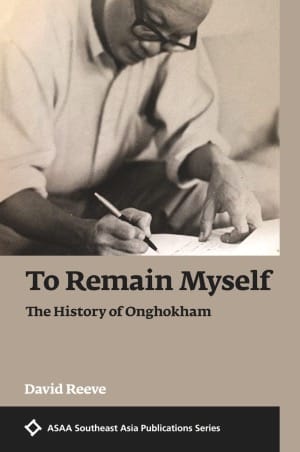
Claim: Onghokham's history of Java, its priyayi and its peasants, came out of a life Reeve tells in full, sexuality and the breakdown of 1966 included, as Ong asked.
Against: The Indonesian life of a public figure that, in Gerry van Klinken's 2007 account quoted on the first page, reveals nothing of its subject's inner self.
Built from: Reeve's interviews with Ong after his 2001 stroke; Ong's letters to Feith, Lev and Anderson, 1962–84; his 1967 statement for a psychiatrist; family, friends, and some 300 articles.
Start with: Chapter 5, "Breakdown and Jail" (pp. 153–79): the title comes from it, and it is where Reeve shows his working.
"The key point here is that Pramoedya wrote his best history in his novels, but that Ong put his best stories into his history." (p. 298)
In 2002 David Reeve asked Onghokham for his mother's name. Ong had had a severe stroke the year before, and on bad days his speech came out as gasps. He said the name, as Reeve recalled on a podcast in 2022, "three times with increasing frustration, I couldn't understand it."1 Then Ong grabbed the pen, as he often did, but "his writing was no more coherent than his voice" (p. 3). Reeve settled on a rule: "if it's important, I'll get it from somewhere. And if it's not important, then it doesn't matter."1 Much of the book's method is in that rule. What Ong could no longer say, Reeve found elsewhere: in the letters Ong wrote from Jakarta to Herb Feith, Dan Lev and Benedict Anderson between 1962 and 1984, in a long statement Ong wrote for his psychiatrist in 1967, and among the relatives, students, journalists and diplomats whose names fill two pages of acknowledgements (pp. ix–x).
On some subjects Ong was the only source, and Reeve says so: "For some areas of Ong's life, I am entirely reliant on what he told me" (p. 4). Those are the areas the book's first page says Indonesian life-writing leaves out. That page quotes Gerry van Klinken's survey of the genre, in which the subjects go on "Revealing nothing of their inner selves or the contingency of human relationships" (p. 1), engaged in "constant, aggressive action in the template of the ubiquitous national hero" (p. 1). Reeve's subject was no candidate for that template. Ong Hok Ham, born in Surabaya in 1933, was "of peranakan Chinese descent, from a Dutch-oriented family, with no religion, gay, hard drinking, pork eating" (p. 2). He was also a historian at Universitas Indonesia with a Yale doctorate and, from the late 1970s, a newspaper celebrity. He asked his family and friends "to be truthful about all his faults" (p. 4), and he wanted his sexuality in the book. Reeve claims the result "sets a new standard in Indonesian biography, which is what he wanted" (p. 1).
The two men had joked in the 1980s, as colleagues in the history department at UI, that Reeve would write the life one day. When it came to it, Reeve proposed a thematic structure. Ong nodded, then began at the beginning, and Reeve has told the story "mostly in the order he told it to me" (p. 3). So a book that ties Ong's history of Java to his own life arrives as a chronicle, starting in a rented house in southern Surabaya hung with portraits of sugar magnates.
I. Ong grew up Dutch-speaking in a declining peranakan sugar family whose stories became his first research
At the Dutch school Ong made one friend, a Dutch boy who arrived in a car with a driver, in 1941. After the Japanese closed the schools, Ong saw him once more, "selling newspapers on a bridge near Ong's house" (p. 43). Reeve sets this against Rudolf Mrázek's interviews with Jakarta intellectuals of the same generation, among whom such memories were rare, and calls Ong's account "highly unusual and significant" (p. 42). When Mrázek interviewed him in the 1990s, the two men had a drink afterwards, and "as the level fell in the bottle, Ong wept at the memory of school" (p. 42).
The family had "taken the Dutch road" (p. 9), in the phrase of Ong's later mentor G. William Skinner. They spoke Dutch at home. His mother was Lies, his father Klaas, and Ong was Hans. They were a minor branch of the Han and Tan sugar families of East Java, living on what was left of a dowry, and the family history came to Ong as stories told at table: the curse on Lasem, the Chinese bupati of Besuki killed in 1813, the sugar lord of Pasuruan. Those stories became his first research subjects in 1957 and 1958. The family also held that children would repeat their elders' failings. In his 1967 statement Ong wrote that "This sense of ‘inheriting family traits’ puts me sometimes like in a prison, up till now" (p. 30).
Asvi Warman Adam, reviewing in 2023, recalled the mother who walked out for a week after a quarrel, and asked: "Did those factors impact on Ong’s later life and personality?"2The book half answers him, in the same paragraph as the newspaper-selling friend: "Such fears seem to be a significant theme in his life" (p. 43). Reeve names a theme and does not claim a cause. Dick van der Meij pressed further in Wacana in 2024. Ong never seemed to have liked his father, he wrote, and the book says too little about it; "The problem with biographers often is that they have no choice but to act as amateur psychologists."3 On the father, the complaint stands. Klaas appears as the man who lost his money at Monte Carlo (p. 14) and as the household bogeyman of the 1967 statement (p. 25), and Reeve reports Ong's aversion without asking much about it.
The war barely touched the family. They sold the old furniture and porcelain from Lies's warehouses on the black market, and "They seemed to have been able to float above the brutal events with relative ease" (p. 52). Of the family's flight to Malang in 1942, "Ong said later that this experience helped stimulate his sympathy for ordinary people caught up in great events" (p. 48). From reading Stefan Zweig's Marie Antoinette with his mother he took a habit of comparing the Indonesian Revolution with the French that lasted all his life (p. 65).
Much of this rests on what Ong told Reeve in 2002, nearly sixty years after the events, and the book says so. At the end of the second chapter Ong's niece Paoke Hudyana recalls the young Ong as a teller of family tales, and doubts some of them. Reeve adds, and leaves the doubt standing: "I began to wonder how much he had told me might also be affected by those imaginative powers" (p. 74).
II. Ong chose to be Indonesian and argued that Chinese separateness was a colonial creation
Lee Kam Hing, reviewing in the Journal of the Malaysian Branch of the Royal Asiatic Society in 2024, gave Ong's part in the assimilation quarrel of 1959–61 one sentence. Beyond signing a declaration in 1960 "to counter the largely pro-integration Baperki of the totok Chinese, Ong took little part in promoting assimilation and did not write much on the subject later on."4 The sentence makes three claims, and the book contradicts two of them.
Baperki was not the totok party. In Reeve's account the quarrel ran through the peranakan themselves: "the peranakan community was deeply divided over the issue of integrasi (integration) versus asimilasi (assimilation)" (p. 102). Baperki's chairman, Siauw Giok Tjan, held that the Chinese could be an Indonesian suku like the Balinese, good citizens who kept their Chinese-ness. The smaller Star Weekly group, Ong among its best-known voices, held that they should give it up. As for writing little afterwards, the introduction says Ong "continued to write on the theme for another 40 years" (p. 2), and later chapters follow him back to it: a Tempo article of February 1978 on the peranakan and capitalism (p. 225), "Citra Minoritas Pedagang sebagai Setan" in 1984, on why traders were imagined as devils (p. 226), and the seminars he gave after the anti-Chinese violence of May 1998 (p. 279). On the third, his part in promoting the cause, Lee is closer to the book. As the movement turned into an organisation under military patronage, "Ong's interest waned" (p. 106), because "bureaucracy bored him rigid" (p. 106).
Ong's thirty-seven Star Weekly articles of 1958–61 made a historical case. "In effect Ong argued that the Chinese had once been assimilated in Indonesia, and that their relatively recent transformation into an isolated minority was the result of colonialism" (p. 94). The evidence came from Skinner's research in 1957, when Ong took down the testimony of the 89-year-old regent Nitidiningrat about Chinese families that had married into the Javanese aristocracy and become Javanese (pp. 86–88), from a Madurese village where a Muslim peranakan group had all but merged with its neighbours, and from six months in Manila in 1959. When he joined his three names into one, "He did not Indonesianise his name; rather he Philippinised it" (p. 103). His friend Harry Tjan put the generation's position in a sentence: "Ong was Dutch, and I was Javanese; we only became Chinese later" (p. 79).
Here Reeve does what van der Meij, two years after publication, wished he had done for the father: he looks for a motive under the argument. Skinner and the Star Weekly editor P.K. Oyong mattered, he allows, "But even more important than these was his anger and frustration with the Chinese community and his own family" (p. 104). Ong told him: "I didn't like Chinese society, their apolitical isolation from events. I used to get angry" (p. 105). That reading rests mostly on Ong's word in 2002. The other side of the debate gets less. Siauw's case has a paragraph (p. 102), and no Baperki reply to Ong is named by title or date in the section on the polemic (pp. 100–106). Reeve's verdict on the exchange is that "It is not clear whether either side in this debate even listened to the other's killer questions, much less answered them" (p. 103).
By the time thirty signatories put their names to the Assimilation Charter at Bandungan on 14 January 1961 (p. 106), Ong was already a history student. He had decided in 1959, at 26 and getting nowhere in law, to go back to serious study in history: "What else was I going to do?" (p. 106)
III. From 1962 Ong turned to Java's peasants and read their resistance through the wayang
In October 1962 a priyayi in Malang lent Ong a secret report on the Samin movement written in 1917 by Resident J.E. Jaspers, about a hundred pages long. "In all my hunting for books I think that this report has been the best find in my career" (p. 126), Ong wrote to Dan Lev in November. It became the spine of his undergraduate thesis of 1964, which read the Samin peasants' refusal of the colonial state was "a form of Bima cult, Bima being a major figure in the wayang" (p. 141). According to Reeve, most later work on the Samin, by anthropologists as well as historians, still cites it (p. 142).
The turn had begun that Lebaran, in a village between Solo and Boyolali, where Ong went with Ben Anderson and Mary Somers to the family of a student friend. He was astonished that villagers without electricity followed cabinet reshuffles on battery radios, and he put it in wayang terms: the elite reasoned like the heroes, the villagers like the clown-servants Semar and Petruk (p. 124). Abidin Kusno, in the American Historical Review in 2025, thought Reeve so taken with Ong's approach that he "came close to saying that Ong's studies of Java inspired a generation" of Cornell scholars.5 Van der Meij read the influence the other way. He fixed on Jamie Mackie's remark that Ong had "fallen for the whole Cornell/Benedict Anderson approach" (p. 139), and asked for a study of what Cornell did to Indonesian scholars.3 The page the two reviewers are arguing over declines to choose: "He said that Ben Anderson had introduced him to Javanese culture; Ben Anderson wrote that Ong had introduced him to Javanese culture. They must have been egging each other on" (p. 124).
Ong's letters to Lev, Anderson and Feith from 1962 to 1965 carry the chapter. Ron Witton, who knew Ong and reviewed the book in Inside Indonesia in 2023, valued them because Ong's analyses of particular moments are "only available in the letters he wrote to close friends and colleagues",6 and found them "nothing short of breathtaking".6 They report the PKI and its opponents squaring up in the villages. In late 1964 Ong writes that people everywhere seemed to be waiting for "the day of final reckoning" (p. 144) and preparing for the Bharata Yuda, the last battle of the wayang. Van der Meij listed the letter's spelling of that battle, Joyobinangan, among the book's errors;3 the spelling is Ong's, and the glossary prints Joyobinangun (p. 300). A ten-page letter of 1 March 1965 describes the PKI's unilateral land seizures in East Java and the Muslim youth gathering against them (pp. 147–50). In mid-1965 he toured East Java and watched Islamic drum bands drilling. He came back to Jakarta on the overnight train of 30 September 1965 and stepped off at Gambir station at three or four in the morning (p. 152).
IV. Ong's breakdown of 1965–66 came, he insisted, from the political crisis and from his sexuality
"In 2002, it took Ong until the third month of interviews to tell me that he had been in jail in 1966 and had had a nervous breakdown" (p. 160). Then he gave Reeve two questions to answer: why had he been jailed, and for how long. He had never been charged, and a letter from the university asking why got no reply. Witnesses remembered anything from a couple of nights to a year. After four years of work, in 2006, Reeve read Ong his answer: "You were in jail, by my reckoning, from about 10 March 1966 to about 28 September 1966, a period of some six months and two weeks, or around 150 days" (p. 161).
Then letters turned up. Ben Anderson wrote to Lance Castles in August 1966 that Ong "has been held in Glodok—i.e. rearrested" (p. 166), and Nugroho Notosusanto had written to Feith in May that Ong was home again. Reeve revised his answer: "My final assessment is that Ong was jailed from March to May 1966, then rearrested and jailed from July to September" (p. 166). Ong died before he could hear it. The first answer has outlived the revision. On the podcast in September 2022 Reeve himself gave the single detention, "jailed for six months from March to about the end of September 66",1 and in 2023 Asvi Warman Adam had Ong "detained from March to September" 1966.2
For the arrests the book gives two reasons. Reeve "came to believe it was both, in turn" (p. 166): first Ong's public shouting for the PKI, then a letter found in his trouser pocket outlining the Cornell Paper. Kusno, in 2025, had the two spells but one cause: the cries, he wrote, "landed him in jail" twice.5 McDonald's notice has Ong "released as temporarily deranged".7 In the book he was released on a personal guarantee from Nugroho, then a historian at UI and later Suharto's court historian: "If Ong is Communist, then I too am a Communist" (p. 165). The note went to the military in a small white envelope that, to the colleague who carried it, looked like an invitation to a dance (p. 165).
The breakdown itself has two sources, and Reeve keeps both. One is political. In October 1965 the army gave seized PKI branch records to a team from the UI History Department to find proof of conspiracy; Ong found none, "Of course, there was none" (p. 155), and found instead peasants' letters about class. Kusno took this experience to have "inspired the writing of important papers at Cornell on the history of the PKI".5 Reeve is more cautious about the Cornell Paper: Ong was "an important source, but far from being the only one" (p. 169), and Anderson told him the letters confirmed directions already taken. A footnote does credit Ong's stories with inspiring Ruth McVey's later article on the PKI as a school (p. 155). In December Ong went to East Java to look for his family and saw the killings. What he saw there he never told Reeve. "He was unable to speak about them himself. The effect was too deep," Reeve said in 2022.1
The other source is sexual. Ong was still a virgin at thirty, in 1963; in the two years that followed he cruised Lapangan Banteng and the grounds of the National Monument and talked about it to almost no one, and "Ong insisted to me that his mental turmoil from late 1965 was partly due to the political crisis and partly about resolving his sexuality" (p. 136). The young men he imagined persecuting him in early 1966 were attractive ones (p. 157). In 2002 Reeve met the psychiatrist who had treated Ong, Dr Kusumanto Setyonegoro; his records had been lost, and he remembered that "Ong had spoken mainly of two topics, being Chinese and his sexual orientation" (p. 168).
The statement Ong wrote for Kusumanto in 1967 nearly leaves sexuality out. It is "almost entirely absent in this more public document" (p. 175), and Ong writes instead of "having passed a time of confusion and certain unpleasant experiences" (p. 173) whose causes he does not know.
The book takes its title from the last sentence of the statement, in which Ong saw himself struggling with people who wanted to make something of him, "while I wanted to remain myself" (p. 176). Francesca Beddie, a former diplomat who met Ong in Jakarta in the 1980s, opened her 2023 review with that sentence and called it "Onghokham speaking to his biographer, David Reeve."8 It reads as if it came from the interviews. It is a written sentence, addressed to a psychiatrist in September 1967, thirty-five years before Reeve's first interview. Beddie also objected to a word on the same page: Suharto's rule was "authoritarian (not, I would argue, totalitarian, as Reeve calls it)."8 Reeve does write that Ong had to compromise "to exist under the totalitarian New Order" (p. 176). But the word was Ong's first. Recalling in 2002 how he saw the student activists of 1966, he said they were "a new totalitarian regime, a military regime, the New Order" (p. 156). Beddie's quarrel is also with Ong.
In September 1968 five friends, McVey, Anderson, Feith, Lev and Castles, put in two hundred dollars each and sent him to Yale on what he thought was a scholarship (p. 178).
V. Ong's Yale thesis argued that Madiun's landholding peasants rebelled over land and tax
"It washed his problems away," Reeve said of America in 2022.1 The book is quieter: Ong remembered the day he left Indonesia as "one of the happiest days of his life" (p. 183), lived for the first time with a lover, and learned to cook. Harry Benda, his supervisor, pointed him to peasant revolts and to Karl Wittfogel's oriental despotism (p. 184), then died in 1971 while Ong was in the Dutch archives. Three supervisors on one-year contracts followed. To Fred and Alice Bunnell the whole thesis "looked something of disordered mess" (p. 193). Ong submitted in February 1975.
The thesis, on the Residency of Madiun from the sixteenth century to 1916, argues that Dutch rule and the old Mataram aristocracy together made a colonial state more monolithic than either had been alone, and that what drove the unrest in its villages was land. Reeve sums it up: "There was a direct causal relation between taxes, the fragmentation of land, landownership patterns and rural unrest" (p. 197). Ong told him that "possibly his most original contribution was to discuss the landowning peasants and issues of land, tax and change" (p. 196). The rebels in his Madiun were sikep, tax-paying smallholders, not the landless. Kusno suggested in 2025 that the thesis could be counted as early subaltern history.5 Ong had his own name for the method. Of a 1977 article on a Madiun tax revolt he wrote that he had tried "reverse historiography, present the common people as rational and those at the top as not, even as blind" (p. 213).
That set him against Sartono Kartodirdjo, whose thesis on the Banten revolt of 1888 gave weight to the hope of a just king. In Reeve's comparison, Ong's "complex set of interacting factors" (p. 199) boiled down "to a single central issue, the issue of landholding and land tax" (p. 199). Asvi Warman Adam put the contrast the same way in 2023: messianic expectation for Sartono, excessive taxes for Ong.2 Reeve's ranking follows: "Sartono was the greater scholar" (p. 199). McDonald caught that judgment, "Reeve is not uncritical",7and found the thesis "richer in anecdote than social theory".7 The book had already granted part of this. Reeve reports the charges against both schools, that UGM's historians never left the land and the interior for the coasts and that UI's wrote "just narrative and description, without theory" (p. 199), and says: "There is fair bit of justice in both criticisms" (p. 199).
The book's dates for the thesis do not agree with each other. It was "completed at Yale in 1975" (p. 200), yet the Indonesian edition of 2018 appeared "41 years after its completion" (p. 198). Ong thought he could have had a post in America, Holland or Singapore, and came home in mid-1975 instead: "So, as he had done in the 1950s, Ong chose Indonesia" (p. 201).
VI. Ong wrote his history as stories for Tempo and Prisma, and never wrote the big book
Reeve counts twenty-four scholarly pieces in Prisma over fifteen years and reckons them the equivalent of two or three big books (p. 206). The book of the thesis was never written. Ong said he was bored; Reeve adds that he no longer needed it: "Other historians may have needed a big book to establish themselves on the scene; Ong did not. He already had a position and public status" (p. 218). From late 1976 Tempo ran him with a by-line and a photograph. On the podcast Reeve described the day's round, from newspaper offices to embassy receptions at night, where diplomats found a man who "knew the stories that the editors dared not print".1 Over whisky, "So he blabbed."1 The university, meanwhile, retired him at 56, because, it turned out, he had always been casual staff and had never had a civil-servant number (p. 249).
The articles had a pattern, which Reeve sets out on p. 240: a topical hook, a leap back to the nineteenth century, comparisons with Europe or Latin America, Javanese detail. Their endings were less dependable. Goenawan Mohamad, the founder of Tempo and one of his editors, said that while most articles had a beginning, middle and end, "Ong’s were all middle" (p. 239), a line Beddie repeated,8 and van der Meij picked up the remark that, with Ong's ideas, "it was not always easy to get to them" (p. 239).3 Reeve's advice to readers is practical: "it is better to trust the conclusions that flow directly from the argument; otherwise stay with the middle" (p. 240). At the paranormal conference in Semarang in 1985 the middle was a theory of tuyul, the Javanese thieving spirits. Ong's case was that the belief showed Javanese refused wealth the legitimacy they granted power: "He made much of the contrast between power in Java, which was legitimate, and wealth, which was not" (p. 245).
How much he wrote is itself disputed. Asvi wrote in 2023 that Ong "reportedly wrote 360 articles, but only 170 are listed" in the biography.2 Van der Meij praised the same appendix as a complete list of publications: "This is how it should be."3 The appendix opens: "One hundred and seventy of Ong’s articles now appear in the collections cited below" (p. 305). The 170 are the articles since reprinted in book form. Van der Meij read the appendix correctly: the list itself runs from 1958 to 2019 and well past three hundred titles.
Lee Kam Hing's summary was that "lacking self-discipline, he did not produce many more academic writings that he was capable of. Nevertheless, he raised lots of new ideas that others later took up."4 Reeve's closing chapter had already named the people who took them up: Henk Schulte Nordholt on the jago, Susanto Zuhdi on Pancasila as compromise, J.J. Rizal and Fadly Rahman on food (p. 297). Witton thought Ong would be "best remembered for his innovative" analysis of colonial and pre-colonial Java,6 and quoted Reeve on Ong's quarrel with historians who saw peasants as "passive and accepting" (p. 219). Reeve's own account is bleaker. The idea Ong was proudest of, he writes, "the link between land, tax and rebellion, has not much been taken up. His central idea has gone missing; perhaps it will be taken up later, but perhaps it has gone for good" (p. 297).
The thesis was translated into Indonesian in 2018, through Peter Carey's efforts, and launched in Madiun by the local government. "It sold out." (p. 291)
The flyleaf
- p. 1. Van Klinken on Indonesian biography as self-promotion without an inner life: the position the book is written against.
- p. 2. "Ong chose Indonesia three times": 1952, 1975, and the deathbed choice of an institute for Indonesian history rather than Chinese.
- p. 4. "I am entirely reliant on what he told me": the admission that governs the chapters on sexuality.
- p. 42. Ong weeping over the memory of his Dutch school, set against Mrázek's other interviewees.
- p. 74. Reeve's doubt about Ong's "imaginative powers" as a source.
- p. 94. Ong's assimilation argument in one paragraph: the Chinese as once assimilated, separated by colonial policy.
- p. 102. The integrasi–asimilasi split as a quarrel among the peranakan; Lee Kam Hing reads it otherwise.
- p. 124. Ong and Anderson each crediting the other with the discovery of Java; the passage Kusno and van der Meij read in opposite directions.
- p. 141. The Samin movement as a Bima cult: the core of the 1964 thesis.
- pp. 160–66. Reeve's four-year reconstruction of the 1966 detention, and his revision of it.
- p. 168. Dr Kusumanto's memory of what Ong talked about in treatment.
- p. 176. The sentence that gives the book its title, and the word "totalitarian" Beddie objected to.
- pp. 194–97. The Madiun thesis: oriental despotism, the sikep, land and tax.
- p. 199. Ong and Sartono compared; "Sartono was the greater scholar".
- p. 297. Who took up Ong's ideas, and the central idea that nobody did.
The shelf
- Read against: Sartono Kartodirdjo, The Peasants' Revolt of Banten in 1888: Its Conditions, Course and Sequel (Martinus Nijhoff, 1966). The other founding thesis of the period, which finds room for messianic hope where Ong found the land tax.
- Read next: Onghokham, Madiun dalam Kemelut Sejarah: Priayi dan Petani di Keresidenan Madiun Abad XIX (Kepustakaan Populer Gramedia, 2018). The Yale thesis itself, in the Indonesian translation Carey arranged.
- Builds on: David Reeve, Wasmi Alhaziri and J.J. Rizal, eds, Onze Ong: Onghokham dalam Kenangan (Komunitas Bambu, 2007). The memorial volume of fifty-two memoirs, assembled in the hundred days after Ong's death, on which the biography draws throughout.
- Read next: Rudolf Mrázek, A Certain Age: Colonial Jakarta through the Memories of Its Intellectuals (Duke University Press, 2010). Ong's generation remembering their Dutch schooling, mostly with less pain than he did.
Notes
- Michele Ford, "David Reeve, 'To Remain Myself: The History of Onghokham'", New Books in Southeast Asian Studies, New Books Network, 15 September 2022, https://newbooksnetwork.com/david-reeve-to-remain-myself-the-history-of-onghokham-asaa-southeast-asia-publications-series-nus-press-2022. Passages at 04:57 (mother's name), 19:02 (East Java), 20:00 (detention), 23:21 (America), 28:56–29:23 (diplomats).
- Asvi Warman Adam, review of David Reeve, To Remain Myself, Bijdragen tot de taal-, land- en volkenkunde 179 (2023): 142–44, https://doi.org/10.1163/22134379-17901009.
- Dick van der Meij, "David Reeve, To remain myself; The history of Onghokham", Wacana: Journal of the Humanities of Indonesia 26, no. 2 (2025): 330–32, posted 30 April 2024, https://doi.org/10.17510/wacana.v26i2.1936.
- Lee Kam Hing, review of David Reeve, To Remain Myself, Journal of the Malaysian Branch of the Royal Asiatic Society 97, pt 1, no. 326 (June 2024): 180–83, https://doi.org/10.1353/ras.2024.a932118.
- Abidin Kusno, review of David Reeve, To Remain Myself, American Historical Review 130, no. 3 (September 2025): 1257–58, https://doi.org/10.1093/ahr/rhaf371.
- Ron Witton, "Review: The history of Onghokham", Inside Indonesia 151 (January–March 2023), https://www.insideindonesia.org/review-the-history-of-onghokham.
- Hamish McDonald, "To Remain Myself: The History of Onghokham", The Saturday Paper, no. 417, 17–23 September 2022.
- Francesca Beddie, "To Remain Myself, the History of Onghokham", Professional Historians Australia (NSW & ACT), 31 July 2023, https://www.historians.org.au/book-reviews/toremainmyself.