Common Mosses of the Northeast and Appalachians

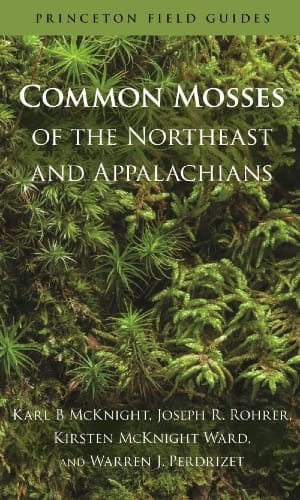

Karl B McKnight, Joseph R. Rohrer, Kirsten McKnight Ward and Warren J. Perdrizet. Princeton University Press, 2013 · 392 pages · Princeton Field Guides, ISBN 978-0-691-15696-5
- Claim: Three features visible through a hand lens (growth form, leaf shape, midrib) are enough to sort 153 common eastern mosses, and the page for each moss can do the rest.
- Against: The compound-microscope floras that, in Dale Vitt's 2013 account, were the eastern beginner's only references: expensive, hard to use, and useless without a microscope.
- Built from: Photographs taken with permission at the University of Michigan Biological Station, the Chewonki Foundation, Trustees of Reservations land in Massachusetts and state and national forests; 600-plus line drawings from Crum and Anderson (1981).
- Start with: "How to Use the Identification Keys" (p. 340), because it says what the method concedes.
“It need not match every detail of your specimen perfectly; choose whichever lead is a more accurate description of the moss you wish to identify.” (p. 340)
The book's sample page, the one that teaches a reader how to read an entry, is built on a moss whose leaves are too small for the book's own method. The moss is Platydictya subtilis, a creeping thread of a plant, and its Leaves line reads: “Midrib is lacking, but too small to verify with hand lens.” (p. 8) The full entry, on p. 229, gives the leaf length as 0.2–0.5 mm. The key that organizes the guide turns on a midrib, present or absent, and here, on the page that explains the system, the guide tells its reader that the recommended instrument may not settle the question.
Four people made it. J. M. Budke, reviewing it in the Plant Science Bulletin in 2013, counted “two botany professors, a professional artist, and a former undergraduate biology student”.[1] They wrote for people who own a hand lens and no microscope, and they dedicated the book to a naturalist, Jerry Jenkins, “without whom this book would have been unimagined and impossible” (p. 5).
The field they entered was a field of floras. Dale Vitt, a bryologist at Southern Illinois University who reviewed the guide for Systematic Botany in 2013, put the position bluntly: most manuals had used “features seen only with the aid of the compound microscope”, and for a novice the standing references, Crum and Anderson's among them, were “expensive and hard to use”.[2] He knew the alternative from the inside. A moss, lichen and fern guide for northwestern North America, made with the Alberta publisher Lone Pine, had “sold well over 15,000 copies”, and the eastern half of the continent, he wrote, “has up to now not had a regional photographic guide”.[2:1]
What the four authors put in the microscope's place is three characters. A reader decides whether the plant is an acrocarp, a pleurocarp or a peat moss; whether its leaves are hairlike, lance-shaped, ovate, tongue-shaped, sickle-shaped or absent; and whether each leaf has a midrib. The answers lead to a run of pages marked by colour at the page edge, or to one of twelve dichotomous keys at the back. Whether anyone can see those three things on a leaf a few millimetres long is the question the reviews turn on, and the book's own pages, read against them, answer it more candidly than several of the reviews do.
I. Three features seen through a hand lens are enough to sort the common mosses.
Ross Koning, a biologist at Eastern Connecticut State University who reviewed the guide for the American Biology Teacher in January 2014, praised what the colour swatches do for a person holding the closed book: it lets the reader “fan open the book to the subgroup you seek in three selections looking only at the page edges”.[3] The book states the plan in its first numbered step, “Determine the three Key Features of your moss” (p. 9), sets the three out on pp. 10–15, and puts the combinations on a two-page diagram (pp. 16–17) that gives page numbers and a key for each.
Lars Hedenäs, a bryologist at the Swedish Museum of Natural History, made the same observation about colour in the Botanical Journal of the Linnean Society later in 2013: after some practice the user would find the right section “since these are seen also when the book is closed”.[4] Gary Walker of Appalachian State University, in the Appalachian Journal, noted that the guide gives two ways in, the margin colours or the three features used as a path to the traditional keys.[5] Nancy Slack, a botanist at the Sage Colleges, called the Path to the Keys “innovative” in Rhodora.[6] Budke added a figure for the keys behind the tabs: they are “not intimidating in length”, and the majority of species are identified in less than ten couplets.[1:1] Nobody who tried the scheme faulted its layout. What was disputed was the vocabulary.
Vitt disputed the first of the three words. Acrocarpy and pleurocarpy, he explained, “refer exclusively to position of the female sexual structure” and do not name growth forms; he would have preferred the plain pair, unbranched against freely branched.[2:2] He also granted what the book relies on: the position of that structure “often means that acrocarps are erect and unbranched while pleurocarps are horizontal and have branches”.[2:3] The book's definitions are written in those terms. Its acrocarp has “Stems simple or sparsely forked” and “Plants packed together like tufts of carpet” (p. 10); its pleurocarp has “Stems branch freely and at a wide angle” (p. 11). It also half concedes Vitt's point about the female structure: next to the acrocarp's capsules it adds that they arise from the stem tip, “but later growth can disguise this trait” (p. 10). That is as far as the page goes toward him, and it is far enough that his objection reads as a request about vocabulary and not as a flaw in the sorting.
In 2019, six years after the reviews, the naturalist Emily Stone described a workshop in Wisconsin at which Rohrer taught from the book, and her account shows the terms at work in a teacher's hand. Holding up a stem, Rohrer said, in Stone's transcription, that “this acrocarp moss is very upright, and if there are branches, they run parallel to each other”.[7] That is p. 10 in speech. It is not a reply to Vitt, who had written long before, but it shows the pair of words taught as growth forms and received that way.
II. The sorting fails where the leaf is too small to read, and the book allows for it.
Robin Wall Kimmerer put the guide to a test that no other reviewer ran. She gave it to her class, Ecology of Mosses, at the SUNY College of Environmental Science and Forestry, and reported in The Bryologist in 2013 that after a semester of technical keys the students were “excited by the profuse illustrations and the simple three-step key”.[8] The excitement lasted until they met a leaf. “The requirement of clearly seeing the costa, upon which identification relies, was particularly challenging for them,” she wrote, and they were wishing they could use their microscopes. When the key gave out, they “used the tried-and-true method of flipping through sections simply looking for their target species”.[8:1]
The book names the failure in advance. A reader who reaches a bad match is told to go back: “If you don’t like the match, consider couplets in the key where you were uncertain which lead to follow.” (p. 340) A reader who keeps failing is told that “we may have interpreted leaf shape differently” and that the reader may have “misinterpreted a pleat as a midrib when the leaf actually lacks a midrib” (p. 340). The hazard is drawn earlier, under Tricky Cases: a midrib that fills the whole blade is hard to see, and the page says to peel off a leaf and examine the clasping base (p. 14), while on the next page the second trap is a pleated leaf, whose folds can mimic or hide a midrib (p. 15). The instruction for finding a midrib at all is to “Hold your specimen up so the light shines through a leaf” (p. 14). On p. 19 the concession is blunter: “experience using our guide will help you become better attuned to where we drew the line between the various leaf shapes” (p. 19).
So the book says what Kimmerer's students found. The lines between lance and tongue and ovate are the authors' lines, and a beginner will cross them. Slack found the same on a smaller scale. Beginners she tried the key on “couldn’t decide between ‘ovate’ and ‘tongue’ for a Rhizomnium” and had to use two keys; she does not say which species.[6:1] The page that defines ovate begins “Egg-shaped” (p. 13), and the one entry for the genus that could be checked, Rhizomnium punctatum, gives its leaf as “Round egg shape, widest above middle” (p. 143). On the book's terms that is ovate, and her beginners hesitated anyway. Her count for the whole trial was kinder: the keys “worked on three of four species”.[6:2]
Those who tested the guide least were the most confident. Roger Applegate, in the Canadian Field-Naturalist in 2013, repeated the book's claim that any moss in the region can be identified with a hand lens and a spray bottle, found it accurate, and added the one tool he would carry, “an Xacto knife or razor blade”.[9] Justine Weber, a teaching assistant to a moss ecology class who reviewed it on the Nemesis Bird blog in April 2013, had used it for two months and concluded: “after two months of use, I’m still not sure that a moss field guide is a watertight concept.”[10] An unsigned, undated note on the Ohio Moss and Lichen Association's resource page made the same reservation without the weather: the field approach “might not be entirely practical as the primary identification methodology”.[11]
Kimmerer's other complaint from the classroom was the photographs: “The complete absence of scale in the photographs is a significant shortcoming”.[8:2] The book does print a scale, though not where she looked for it. “Millimeter rulers are printed inside the front cover of the book and on the left sides of the identification key pages for convenience measuring leaves” (p. 19), and the same page adds that a reader might want to carry a ruler of their own. The rulers serve a reader who already has a specimen in hand, which is the reader the keys address; a reader paging through the photographs has none beside the picture, and Kimmerer's students were paging.
Budke's praise points at a different part of the design. She thought it “a wise choice to center the images and identification on gametophyte features”, the leafy plant, since the capsule on its stalk varies by season.[1:2] The book is less committed to that than she is. Every entry carries a heading for capsules, and the passage on how to look at a moss says plainly that the capsule's shape and orientation, with its lid and hood, are sometimes essential to an identification (pp. 19–20). The three-feature key avoids the capsule; the book does not claim that a reader always can. Weber's phrase for what the guide gave her at the end of two months was modest and exact: it “will probably give you a list of ‘maybes’”.[10:1] A list of maybes is what the Similar Species paragraphs are written to produce, and the next proposition turns to them.
III. Habitat and look-alike pages are meant to catch what the three features miss.
The second step of the method, in the book's own list, is a check against neighbours: “Compare your specimen to similar species, where confusing look-alikes are contrasted.” (p. 9) Every entry has a Similar Species paragraph, and the keys' instructions repeat the step at the point of a match, telling the reader to “perhaps check those pages as well” (p. 340).
Four reviewers noticed, from four angles. Walker thought the similar-species section among the book's “most uniquely valuable aspects”.[5:1] Koning counted perhaps another fifty look-alikes beyond the 153 full entries;[3:1] Budke put the figure at 46 taxa “not covered elsewhere in the book”.[1:3] Hedenäs noticed that when a look-alike is close enough to confuse, it is drawn on the left-hand page beside the main species.[4:1] They describe one fact, which is that the design assumes the key will sometimes send the reader to the wrong page and builds the correction in.
Kimmerer wanted a correction that came earlier. Her complaint was that the authors “missed an opportunity” by leaving habitat out of the identification itself: for a moss on the exposed roots of a hemlock, “the field of probable candidates is only around a dozen”, and a key that knew this would spare the reader 200 species.[8:3] She credited the Habitat Lists on pp. 380–383 and wanted that approach expanded into the key. The book shares her premise: “Moss identification is often aided by knowing where the plant was growing.” (p. 18) It puts the knowledge at the back, as lists. By a count of the entries, the list for Tree Bases runs to 34 names and the one for Rotten Logs and Stumps to 29, and the book says of them only that “These groups are not comprehensive, but do suggest characteristic species of each habitat type” (p. 380). Platydictya subtilis, the moss of the sample page, is on the Tree Bases list.
On this point her objection stands. Thirty-four names is not a dozen, and a list is not a key; the page that offers the lists says what they are for and does not say why they stop there.
IV. Names are part of the method, and each moss is given one chosen to be remembered.
“Common names can be very evocative and memorable, such as the Pincushion Moss, Knight’s Plume, and Brocade Moss” (p. 385). The sentence comes from the page on moss names, and it is followed at once by the case against: “common names have not been standardized for mosses, so using them to communicate can cause confusion when different people use different common names” (p. 385). The scientific names, the authors add, “have the advantage of being understood worldwide”, and they follow the Flora of North America for them (p. 385). The guide then gives every one of its mosses a common name anyway.
Vitt's sharpest paragraph is about that. The common names, he wrote, “are sort of silly and appear to have just been made up”, and he picked the case he knew best: the usual names for Pleurozium schreberi, probably the commonest moss of the boreal forest, are big red stem and Schreber's moss, and the guide calls it Phoenix Feather Moss (index, p. 287), which he found strange.[2:4] Slack, with less heat, observed that the names are “some of which seem to have been invented by the authors”, and asked whether a moss needs one, since many non-professionals use scientific names for garden plants.[6:3]
Hedenäs read the same kind of sentence with pleasure. He chose three of the book's phrases to admire, and all three can be checked: Syntrichia ruralis “look like long pineapple tops” (p. 157); the capsule of Brachythecium rivulare is “bent like a field hockey club” (p. 247); and the head of Sphagnum wulfianum is “resembling a pom-pom or a dry head of clover” (p. 321). What he valued was “the unpretentious way in which details are described”.[4:2] He defended the same instinct in the vocabulary: to call cell projections “bumps” and rhizoids “brown fuzz” is sensible in such a book, “so why frighten them away by strange words before you have caught them?”[4:3] The Ohio association's anonymous reviewer, who praised “wonderfully imaginative common names” and singled out Tornado moss, Medusa moss and Oil-spill moss, sided with Hedenäs.[11:1] The index bears the list out: Tall Tornado Moss on p. 77, Tiny Tornado Moss on p. 79, where the capsule teeth are “twisted, like a tornado” (p. 79), and Oil Spill Moss on p. 223, where the plants look “glossy or oily-looking” (p. 223).
Vitt's complaint and Hedenäs's praise concern the same sentences read for different purposes. Stone's 2019 column, written six years after the reviews and not in reply to any of them, gives the authors' purpose as a workshop participant understood it: “the book team made up memorable and descriptive common names to help us regular folks”.[7:1]
What Vitt wanted instead was history: “snippets about mosses that would have made for remembering species”, of the kind Howard Crum told about Mungo Park and a Fissidens.[2:5] The book has touches of it. Buxbaumia aphylla “looks more like a fungus than a plant” and “has also been called Bug-on-a-stick” (p. 317); the peat moss head is compared to “British royal guards with their bearskin hats” (p. 321); and the entry for Fissidens bryoides offers advice instead of a story: “If you see a minute Fissidens on a rock beside a river, call it bryoides.” (p. 165) These are a few lines in 200 entries. Vitt asked for more, and the page on names, which is about naming and not about storytelling, does not promise it.
V. The peat mosses cannot be named reliably by sight, and the book says as much.
“Peat mosses are mosses. You will find more than a dozen species described in this book.” (p. 24) The sentence opens the guide's account of a genus that gets its own section, pp. 321–339, with ten full entries. The concession comes on p. 325, in the Similar Species paragraph of Sphagnum palustre, after two look-alikes have been named: “Green plants could be any of these three as well as several other species of Sphagnum. Precise species determination usually requires the use of microscopic characters.” (p. 325)
That is as plain as a field guide gets, and it sits where a reader looking at a green peat moss will see it, in the entry for a species the reader has already been sent to. Slack agreed with the content and complained about the scale: there are mosses that “cannot be definitively identified without a microscope”, Sphagnum is one of the genera, and the guide offers a key and good pictures “only for ten species”, when many more can be found in New York, North Carolina, the New Jersey Pine Barrens and the peatlands near Eagle Hill in Maine.[6:4] She and Kimmerer pull in opposite directions here. Slack wants more peat mosses; Kimmerer wanted a book “that focuses on a smaller subset of common but more distinctive species”.[8:4]
Vitt found a couple of misidentifications and said both could be argued to be taxonomic opinion. One of them lies in this section: “The photo of Sphagnum fallax is actually S. angustifolium.” He supported it from the entry, which describes the stem leaves as pinched into a sharp point, true for fallax in his view, while the illustration shows a blunt stem leaf.[2:6] The text is easy to check, and p. 329 gives the stem leaves as “triangular with tip pinched into a sharp point”. The drawing's tip is a bryologist's call, and the piece can report it without ruling on it. The name Sphagnum angustifolium does not appear in the book.
The book's remedy for a genus it cannot key by sight is the last line of every entry, headed Microscopic Features. For the peat mosses those lines read like a different book. The entry on Sphagnum palustre says that “Outer cells of stems and branches have delicate spiral wall thickenings visible with staining” (p. 325), a sentence for a reader with a compound microscope, a stain and a good deal of patience, addressed to someone who has already put the field guide down.
VI. The guide covers only common species and expects its readers to outgrow it.
The title says common, and the instructions for the keys say what that costs: “our keys cover the 200 common mosses that we describe in the book” (p. 340). The next sentence is a forecast: “If you look at enough mosses, surely you will find some of the less common species that we had to omit.” (p. 340) The last hands the reader away: “you will need to use the more comprehensive professional literature.” (p. 340)
Slack ran into the omission in her own trial. Of four species her novices tried, one came out as the wrong species, because the right one was not in the book.[6:5] She suggested the title as a way around the problem, “even though many of the mosses included are not common”, and she named two that would leave a user lost: Seligeria in the Adirondacks and Hylocomiastrum umbratum in the southern Appalachians. Neither is in the book. “All but 13 of the 200” can be found in the Adirondacks, she counted, but there are more than twice as many there.[6:6] Ed Kanze, in the Adirondack Explorer in May 2013, had one omission to report, and it was a love: the guide “leaves out my favorite Adirondack moss, Schistostega pennata”, a moss he also calls luminescent moss and goblin's gold.[12] It is not in the book either.
Kimmerer thought the coverage already wide enough to be “perhaps a bit too ambitious in the scope of species coverage”;[8:5] Slack and Kanze thought it too narrow. Two further reviewers took a different measure. Vitt: “there is no distributional information”, so a reader cannot tell whether a moss is common in the south, the north or the east.[2:7] Budke had the same gap, “species’ distributions are not included in the text”, and added that the guide's focus on broad-ranging mosses explained it without excusing it.[1:4] Koning reports a distribution map inside the front cover showing coverage from the Great Lakes and New England south to Georgia and South Carolina;[3:2] the converted copy read for this piece does not show the endpapers, so the map is his report and not a page. The map he describes would mark where the book reaches, not where each moss lives, and that is the gap Vitt and Budke describe.
Hedenäs read the coverage from further away. Most of the 200 species, he found, “are widespread in North America as well as other parts of the northern temperate zone”, and the guide “therefore deserves a wider audience than suggested by its title”.[4:4] The book itself closes with a page of references to the professional literature, five books and three websites, and an invitation to the two senior authors, each with a departmental address: “Dr. McKnight and Dr. Rohrer welcome suggestions that might improve the next edition of this book.” (p. 384)
The clearest evidence of what the book expects of its readers is how Rohrer used it in Wisconsin. Stone reports that the group began at a rock in a Japanese garden, looking until “two…three…four species materialized where previously we’d just seen green”.[7:2] For the second step, the leaf, “we moved indoors, and used a digital microscope to project fragments of mosses on the big screen”.[7:3] A photograph in her column shows Rohrer checking a moss through his hand lens, and the caption carries the sentence he offered the class: “Mosses are hard because they are small.”[7:4]
The flyleaf
- p. 5. The dedication to Jerry Jenkins, and to Howard Crum and Lewis Anderson, whose line drawings fill the species pages.
- p. 9. The six steps for using the book, including the optional microscope in step 3.
- p. 10. The definitions of acrocarp and pleurocarp by growth form, the pair Vitt disputed.
- p. 14. Tricky Cases: a midrib that fills the whole blade, and the instruction to look with light through the leaf.
- p. 19. The sentence about where the authors "drew the line" between leaf shapes, the one Kimmerer's students ran into.
- p. 24. The statement that peat mosses are mosses, with the count of "more than a dozen".
- p. 143. Rhizomnium punctatum, a leaf described as "Round egg shape", from the genus Slack's beginners could not place.
- p. 229. Platydictya subtilis, whose midrib is "too small to verify with hand lens".
- p. 317. Buxbaumia aphylla, the leafless moss called Bug-on-a-stick.
- p. 325. The Sphagnum caveat and the microscope line for S. palustre.
- p. 329. Sphagnum fallax, the entry behind Vitt's correction.
- p. 340. "How to Use the Identification Keys," including what to do when no couplet fits and the closing handoff to the professional literature.
- p. 380. The Habitat Lists, "not comprehensive".
- p. 385. "Moss Names," the book's defense of common names and of scientific ones.
The shelf
- Builds on: Howard A. Crum and Lewis E. Anderson, Mosses of Eastern North America (Columbia University Press, 1981). Two volumes; the source of the guide's drawings (dedication, p. 5), and one of the floras Vitt names as the compound-microscope references a beginner cannot use.
- Read against: Ralph Pope, Mosses, Liverworts, and Hornworts: A Field Guide to the Common Bryophytes of the Northeast (Comstock Publishing Associates, Cornell University Press, 2016). A 368-page rival whose reviewer, Robert Klips, noted distribution maps, an illustrated glossary and a refusal of contrived common names, which are the things Vitt, Budke and Slack missed or questioned.[13]
- Read next: Robin Wall Kimmerer, Gathering Moss: A Natural and Cultural History of Mosses (Oregon State University Press, 2003). The essays of the reviewer who tested the guide on her class, and the book Stone quotes at the close of her workshop column.
J. M. Budke, review of Common Mosses of the Northeast and Appalachians, Plant Science Bulletin 59, no. 3 (Fall 2013): 131–132, https://aws4.botany.org/psbarchive/issue/2013-v59-no-3.html. ↩︎ ↩︎ ↩︎ ↩︎ ↩︎
Dale H. Vitt, review of Common Mosses of the Northeast and Appalachians, Systematic Botany 38, no. 3 (2013): 858–859, doi:10.1600/036364413X670223. ↩︎ ↩︎ ↩︎ ↩︎ ↩︎ ↩︎ ↩︎ ↩︎
Ross E. Koning, "Plants: Mosses", The American Biology Teacher 76, no. 1 (January 2014): 62–63, doi:10.1525/abt.2014.76.1.13c. ↩︎ ↩︎ ↩︎
Lars Hedenäs, review of Common Mosses of the Northeast and Appalachians, Botanical Journal of the Linnean Society 173, no. 4 (2013): 790–791, doi:10.1111/boj.12056. ↩︎ ↩︎ ↩︎ ↩︎ ↩︎
Gary Walker, review of Common Mosses of the Northeast and Appalachians, Appalachian Journal 41, nos. 1–2 (Fall 2013/Winter 2014): 154–155, doi:10.1353/apl.2013.a955326. ↩︎ ↩︎
Nancy G. Slack, review of Common Mosses of the Northeast and Appalachians, Rhodora 115, no. 963 (2013): 297–299, doi:10.3119/0035-4902-115.963.297. ↩︎ ↩︎ ↩︎ ↩︎ ↩︎ ↩︎ ↩︎
Emily M. Stone, "Natural Connections: Discovering Moss", Cable Natural History Museum blog, 8 November 2019, https://cablemuseumnaturalconnections.blogspot.com/2019/11/discovering-moss.html. Rohrer's words are quoted inside Stone's column, not from a transcript. ↩︎ ↩︎ ↩︎ ↩︎ ↩︎
Robin Wall Kimmerer, "Field Guide to Northeast Mosses", The Bryologist 116, no. 3 (2013): 321–322, doi:10.1639/bryologist-d-13-00058.1. ↩︎ ↩︎ ↩︎ ↩︎ ↩︎ ↩︎
Roger Applegate, review of Common Mosses of the Northeast and Appalachians, The Canadian Field-Naturalist 127, no. 1 (2013): 89, doi:10.22621/cfn.v127i1.1422. ↩︎
Justine Weber, "Review: Common Mosses of the Northeast and Appalachians", Nemesis Bird, 15 April 2013, https://nemesisbird.com/bird-science/review-common-mosses-of-the-northeast-and-appalachians/. ↩︎ ↩︎
Unsigned entry on "Useful Reference Books for Moss Identification", Ohio Moss and Lichen Association, "Bryology Resources", undated, https://ohiomosslichen.org/bryology-resources/. ↩︎ ↩︎
Ed Kanze, "A must for moss mavens", Adirondack Explorer, 1 May 2013, https://www.adirondackexplorer.org/environment/common-mosses-of-the-northeast-and-appalachians/. ↩︎
Robert Klips, review of Ralph Pope, Mosses, Liverworts and Hornworts, Castanea 82, no. 2 (2017): 169–170, doi:10.2179/17-BR001. ↩︎